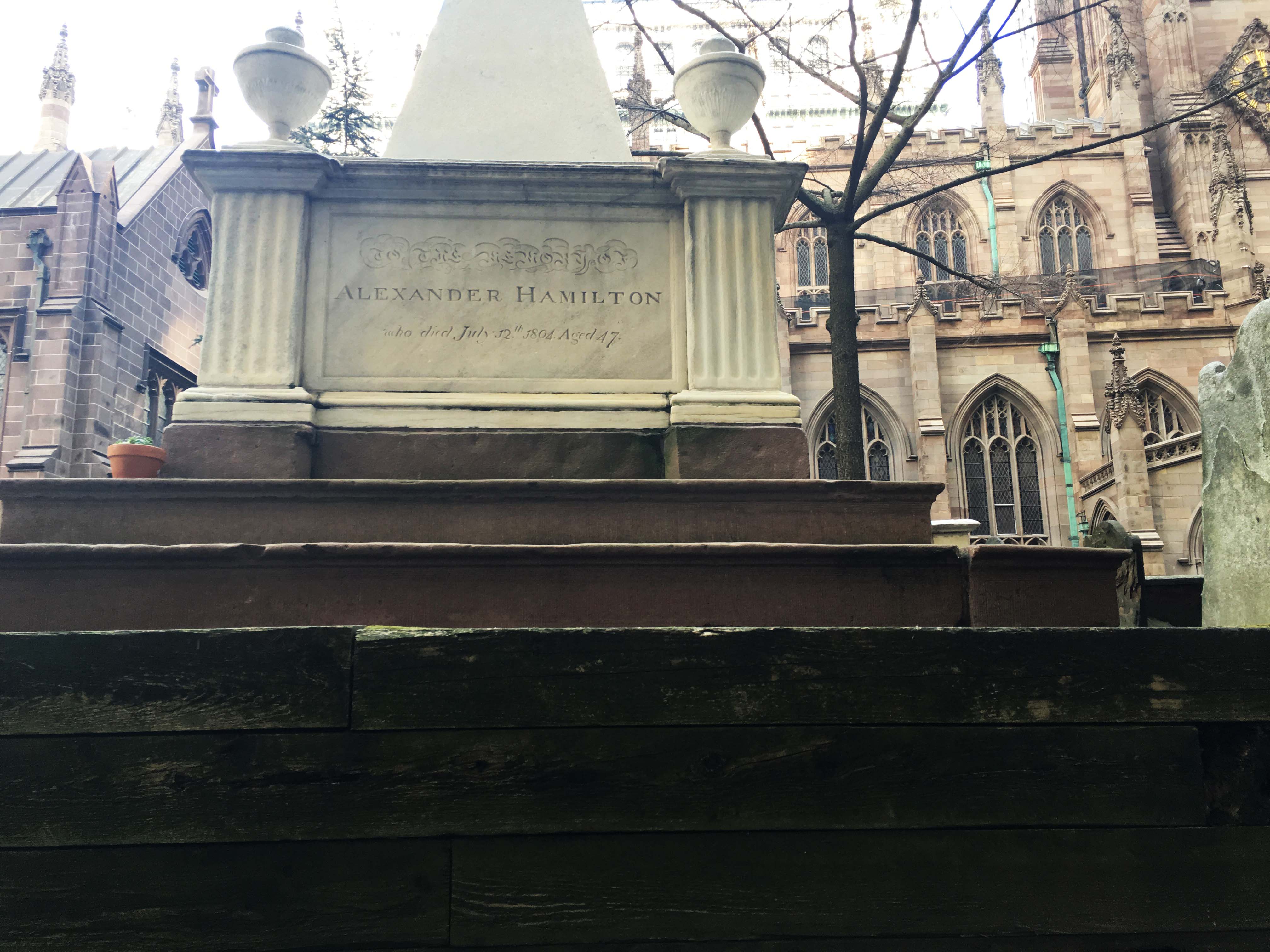
New York City has a way of swallowing history whole. You walk past a skyscraper that was a tavern where George Washington drank, or a subway grate that sits atop an 18th-century cistern, and you never even blink. But then there’s the corner of Wall Street and Broadway. Right there, tucked behind a rusted iron fence, is the Trinity Church Hamilton grave, a slab of white marble that has somehow become a pilgrimage site for teenagers, historians, and confused financial analysts alike.
It’s loud. The 4 train rumbles underneath. Tourists are usually jockeying for a selfie angle that doesn’t include a Starbucks cup in the background. But if you actually stop and look at the monument—really look at it—you realize it’s not just a marker for a man who died in a duel. It’s a messy, physical reminder of how New York treats its legends.
Honestly, most people visit because of the musical. They want to see the spot where the "ten-dollar founding father" ended up after that disastrous morning in Weehawken. Yet, the story of the grave itself, and the woman buried just a few feet away, is way more interesting than the 15-second TikTok clips suggest.
Why the Trinity Church Hamilton Grave is Actually a Cenotaph
Here is the thing about Alexander Hamilton’s final resting place: it is technically a monument, or a cenotaph, sitting atop his remains. It wasn’t always this grand. When Hamilton was rowed back across the Hudson River in 1804, bleeding out from a gunshot wound delivered by Aaron Burr, the city was in a total panic. He died at the home of his friend William Bayard on Jane Street. Trinity Church, where Hamilton had been a pew-holder and a vestryman, was the only logical place for him to go.
The current monument—that pyramid-topped white marble structure—wasn’t erected until years later by the Society of the Cincinnati. If you look closely at the base, you’ll see the marble is heavily weathered. Acid rain and NYC smog have done a number on the inscriptions. It’s a bit crumbly. That’s because it’s made of Italian marble, which looks beautiful but doesn't handle a New York winter particularly well.
He isn't alone there, obviously.
The graveyard is a "who's who" of early American stress. To his left is his wife, Elizabeth Schuyler Hamilton, who outlived him by fifty years. To his right? His eldest son, Philip, who died in a duel at the exact same spot in New Jersey three years before his father. It’s a heavy, tragic family plot that somehow manages to feel peaceful despite the honking taxis ten feet away.
The Architecture of the Monument vs. The Man
Most people expect something more... aggressive. Hamilton was a polarizing figure. People either worshipped his brilliance or thought he was a monarchist snake. But the Trinity Church Hamilton grave is surprisingly restrained. It’s a simple plinth topped by an urn draped in a veil—a classic 19th-century symbol of mourning.
The inscription is what gets me. It calls him the "Patriot of incorruptible Integrity" and the "Soldier of approved Valour." It’s pure 1800s hype-man energy. But it omits the scandal, the debt, and the fact that he was essentially broke when he died.
While you're standing there, look at the orientation. The grave faces the hustle of the Financial District. There is something poetic about the guy who basically invented the American credit system spending eternity staring at the New York Stock Exchange. If you visit on a weekday around 4:00 PM, you’ll see bankers in Patagonia vests walking past the grave without a second glance. It’s the ultimate New York irony.
Eliza's Role in This Spot
We have to talk about Eliza. Without her, this grave might have fallen into obscurity. She spent her five decades of widowhood making sure Hamilton’s legacy was polished to a high shine. She collected his papers, interviewed his colleagues, and made sure he was buried with the dignity she felt he deserved.
Her own marker is a simple stone slab on the ground. It’s flat. It’s understated. In many ways, it’s the most moving part of the Trinity Church Hamilton grave site because it reminds you of the labor required to keep a name alive. People often leave pennies on her stone, or flowers, or even friendship bracelets. It’s a weird, modern tradition that would probably baffle a 19th-century New Yorker, but it shows how much these people still matter to the public imagination.
Getting There Without Getting Frustrated
If you want to see the Trinity Church Hamilton grave, don't just show up at noon on a Saturday. You’ll be surrounded by three hundred people trying to find "The Room Where It Happens."
Go early. Like, 8:30 AM early.
The churchyard opens to the public throughout the day, and it’s free. You enter through the gates on Broadway. The Hamilton monument is on the south side of the church (the left side if you are facing the front door).
- Subway Access: Take the 4 or 5 to Wall Street. You literally exit the station and you are staring at the church.
- Security: There is often a quick bag check or a security guard near the entrance. Don't bring your luggage.
- Etiquette: It’s a cemetery. I know that sounds obvious, but you’d be surprised how many people try to sit on the old gravestones for a photo. Please don't. These stones are fragile.
Surrounding History You Usually Walk Past
While you’re at the Trinity Church Hamilton grave, turn around. You’re missing half the story if you only look at the marble pyramid.
Just a few yards away is the grave of Robert Fulton. He’s the guy who made the steamboat a commercial success. Then there’s Albert Gallatin, the longest-serving Secretary of the Treasury, who was basically Hamilton’s intellectual rival and successor. It’s a dense neighborhood of ghosts.
The church itself is actually the third version. The first one burned down in the Great Fire of 1776. The second was torn down because of structural issues. The one you see now was finished in 1846. This means the church Hamilton attended isn't even the building standing there today, though the ground beneath it has remained the same.
The Burr Connection
People always ask: "Where is Aaron Burr?"
He isn't here. Burr is buried in Princeton Cemetery in New Jersey. Even in death, the two men are separated by the Hudson River. There’s a persistent myth that Burr is buried in an unmarked grave nearby, but that’s total nonsense. He died in Staten Island and was moved to his father’s feet in Princeton.
Actionable Steps for Your Visit
- Check the Church Calendar: Trinity is an active Episcopal parish. If there’s a major service or a funeral, access to the churchyard might be restricted. Check their website before you trek downtown.
- Bring a Penny: It’s a tradition to leave a coin on Hamilton's grave. It dates back to the idea of paying the ferryman (Charon) or simply acknowledging his face on the ten-dollar bill.
- Look for the "Birdhouse" Markers: Some of the older, most weathered stones have little wooden or metal covers to protect them from the elements. These are the truly ancient ones from the 1600s.
- Download a Map: The Trinity Church website has a PDF map of the graveyard. It’s way better than wandering aimlessly and guessing which weathered rock belongs to a Revolutionary War hero.
- Visit St. Paul’s Chapel too: Located a few blocks north, it’s part of the same parish. Hamilton worshipped there while Trinity was being rebuilt, and it’s where George Washington went for a service after his inauguration. It’s much quieter and feels more "authentic" to the period.
The Trinity Church Hamilton grave isn't just a tourist trap. It’s a anchor point for American history in the middle of a city that usually prefers to look forward rather than backward. Whether you’re a history buff or just someone who knows every word to the cast recording, standing in front of that white marble is a reality check. It reminds you that for all the politics and the fighting, everyone eventually ends up in a quiet patch of dirt—even the guy who built the Treasury.