You're sitting in a London flat, it's pitch black outside, and you’ve just finished dinner. It is exactly 6pm UK time. You need to jump on a call with a colleague in Los Angeles or maybe catch a live stream from a creator based in San Francisco. You check your phone. You do the mental math. Or you try to.
It should be simple. But it rarely is.
Converting 6pm UK to PST is one of those daily digital hurdles that sounds easy until you realize that "PST" is a bit of a misnomer for half the year, and "UK time" isn't always GMT. If you're looking for the quick answer: 6pm in the United Kingdom is 10:00 AM Pacific Standard Time. That is an eight-hour gap. Usually.
But honestly, the "usually" is where everyone gets burned. If you’ve ever shown up to a Zoom meeting an hour early or, heaven forbid, an hour late, you know that the friction between Greenwich Mean Time (GMT) or British Summer Time (BST) and the West Coast of the US is a logistical minefield.
The Eight-Hour Rule (And When It Breaks)
Most of the time, the math is static. The UK sits at UTC+0 or UTC+1. The West Coast—encompassing California, Oregon, Washington, and parts of British Columbia—sits at UTC-8 or UTC-7.
When it is 6pm UK to PST, you are looking at a morning start for the Americans.
Think about that for a second. While you are winding down, potentially pouring a glass of wine or scrolling through Netflix, your counterparts in Seattle are just finishing their first cup of coffee. They are checking emails. You are checking out for the day. This massive 8-hour offset creates a very narrow window for collaboration.
But here is the kicker: Daylight Saving Time (DST).
The US and the UK do not change their clocks on the same day. Not even close. The US typically "springs forward" on the second Sunday in March. The UK waits until the last Sunday in March. Then, in the autumn, the US "falls back" on the first Sunday in November, while the UK does it on the last Sunday in October.
During those "shoulder weeks," the gap isn't eight hours. It’s seven.
If you try to convert 6pm UK to PST during that weird two-week window in March, you'll find that it's actually 11:00 AM in Los Angeles. This creates absolute havoc for recurring calendar invites. I’ve seen international product launches delayed and high-stakes interviews missed entirely because someone assumed the 8-hour gap was a law of physics. It isn't. It's a legislative choice.
Why the Afternoon Slump is a Global Problem
There’s a psychological weirdness to this specific time conversion.
6:00 PM is a transition period. In London or Manchester, the workday is over. The "out of office" replies are clicking on. However, for a business owner in PST, 10:00 AM is the peak of the morning "deep work" cycle.
When you ask for a meeting at 6pm UK to PST, you are asking a Californian to talk to you right as they are getting into their flow. Conversely, if a Californian asks for a 10:00 AM meeting, they might not realize they are asking you to sacrifice your evening.
Real-World Stakes: The Gaming and Tech Industry
Take the gaming industry. Many major patches for games like World of Warcraft or Apex Legends (developed by West Coast studios like Blizzard or Respawn) go live around 10:00 AM PST.
For a gamer in the UK, that means waiting until 6:00 PM.
It’s the "Prime Time" slot. You get home from work, you sit down, and the servers are finally up. But if the studio hits a snag and the "10am PST" launch slips by two hours, it’s now 8:00 PM in London. Suddenly, the UK player base is losing their entire evening of gameplay while the devs in California haven't even gone to lunch yet.
The same applies to Apple’s "Special Events." They almost always start at 10:00 AM in Cupertino. If you’re a tech journalist in London, you know your workday doesn't really start until 6pm UK time. You are brewing a fresh pot of coffee while your local friends are heading to the pub. You’ll be writing until midnight.
Navigating the PST vs. PDT Confusion
We need to be pedantic for a second.
- PST is Pacific Standard Time (UTC-8).
- PDT is Pacific Daylight Time (UTC-7).
Technically, if you are looking at a date in July, you aren't looking for 6pm UK to PST. You are looking for 6pm BST to PDT.
The UK moves from GMT to BST (British Summer Time). So, in the summer:
18:00 (BST) minus 7 hours = 11:00 AM (PDT).
Wait. Did you catch that?
In the winter, the gap is 8 hours (18:00 - 8 = 10:00).
In the summer, the gap is still 8 hours (18:00 - 8 = 10:00) because both regions moved forward.
The only time it changes to a 7-hour or 9-hour gap is during those "Sync Lapses" in March and October. It’s a mess. Honestly, the easiest way to handle this is to stop thinking in terms of "PST" and start thinking in terms of "Whatever time it is in Los Angeles right now."
The "Dead Zone" of Communication
If you are working a 9-to-5 in London, and your partner is working a 9-to-5 in San Francisco, you have exactly zero overlapping office hours.
None.
When you start at 9:00 AM, it is 1:00 AM in California. They are asleep.
When they start at 9:00 AM, it is 5:00 PM in the UK. You are leaving.
This is why 6pm UK to PST is the "Golden Window" for freelancers and distributed teams. It represents that one-hour "handover" period where the UK person is willing to stay late and the US person is just starting. If you miss that window, you’re looking at a 24-hour delay in communication. You send an email at your 6:00 PM; they see it at their 10:00 AM, reply at their 4:00 PM, but you don't see it until your 9:00 AM the next day.
Actionable Steps for Flawless Time Conversion
Stop guessing. Use these specific strategies to ensure you never miss that 10:00 AM or 6:00 PM cutoff.
1. Use World Time Buddy, but check the dates
Don't just look at "today." If you are scheduling a meeting for three weeks from now, manually scroll to that date in the calendar view. This is the only way to catch the Daylight Saving shift. Most digital tools are good at this, but human error usually happens because we look at the current offset instead of the future one.
2. Hard-code your Calendar with "Dual Time Zones"
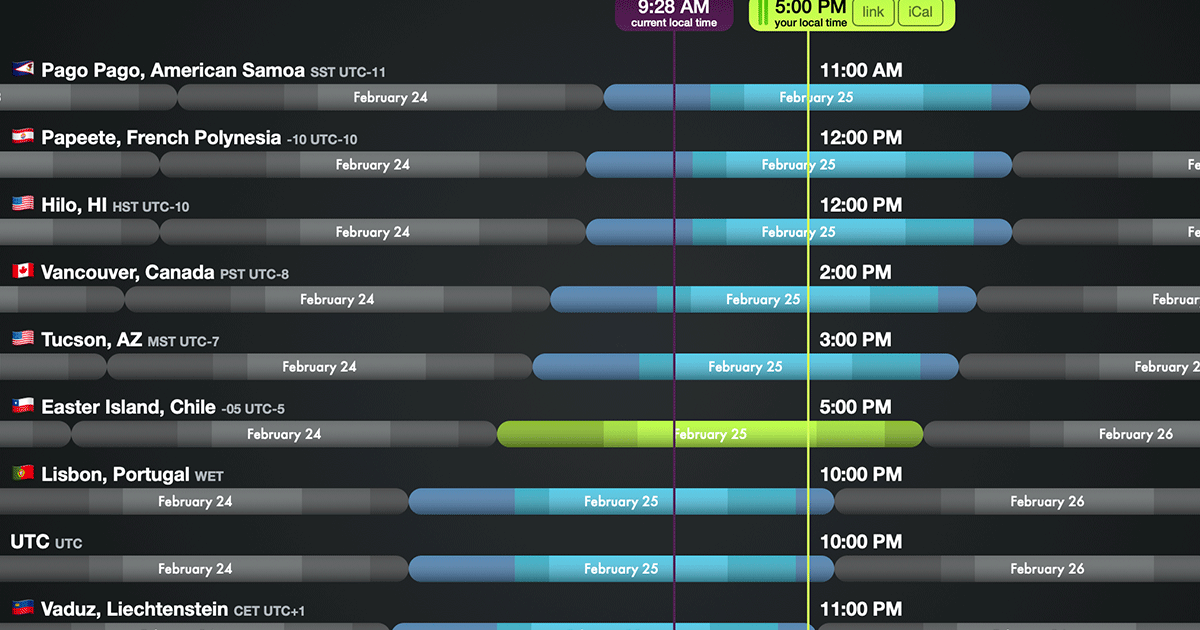
If you use Google Calendar or Outlook, go into settings and enable a second time zone. Set it to "Pacific Time - Los Angeles." This puts a secondary vertical axis on your calendar. When you see a block at 6:00 PM, you can glance to the left and see it’s 10:00 AM. No math required.
3. The "Plus Eight" Shortcut
If you are in the US trying to figure out UK time, add 8.
10:00 AM + 8 hours = 6:00 PM.
If you are in the UK trying to figure out PST, subtract 8.
6:00 PM - 8 hours = 10:00 AM.
(Just remember the "March/October" exception).
4. Specify "Local Time" in Correspondence
Never just say "Let's meet at 6." Always write: "Let's meet at 6:00 PM UK time (which I believe is 10:00 AM your time)." This forces the recipient to double-check their own clock. It’s a "double-entry" bookkeeping method for scheduling.
5. Beware the "Midnight" Trap
If you are converting times later than 6:00 PM, remember the date change. 4:00 PM PST is 12:00 AM (Midnight) in the UK. If you're scheduling a "Monday" late-afternoon meeting in California, it's actually a "Tuesday" morning meeting for the Brit.
Final Technical Check
To be absolutely clear for your records:
- January (Standard Time): 6:00 PM GMT = 10:00 AM PST.
- June (Daylight Time): 6:00 PM BST = 10:00 AM PDT.
- Late March (The Gap): 6:00 PM GMT = 11:00 AM PDT (US has switched, UK hasn't).
The 8-hour gap is the standard. Use it as your baseline. But always verify the specific date against the international DST transition calendar to avoid being the person who stares at a silent Zoom screen for forty minutes.
To manage your schedule effectively, go into your digital calendar settings right now and add "Los Angeles" as a secondary time zone. This simple change eliminates the mental load of subtracting eight every time you receive an invite. For any meetings scheduled in March or October, manually verify the UTC offset on a site like TimeAndDate.com to account for the mismatched Daylight Saving shifts between the US and the UK.