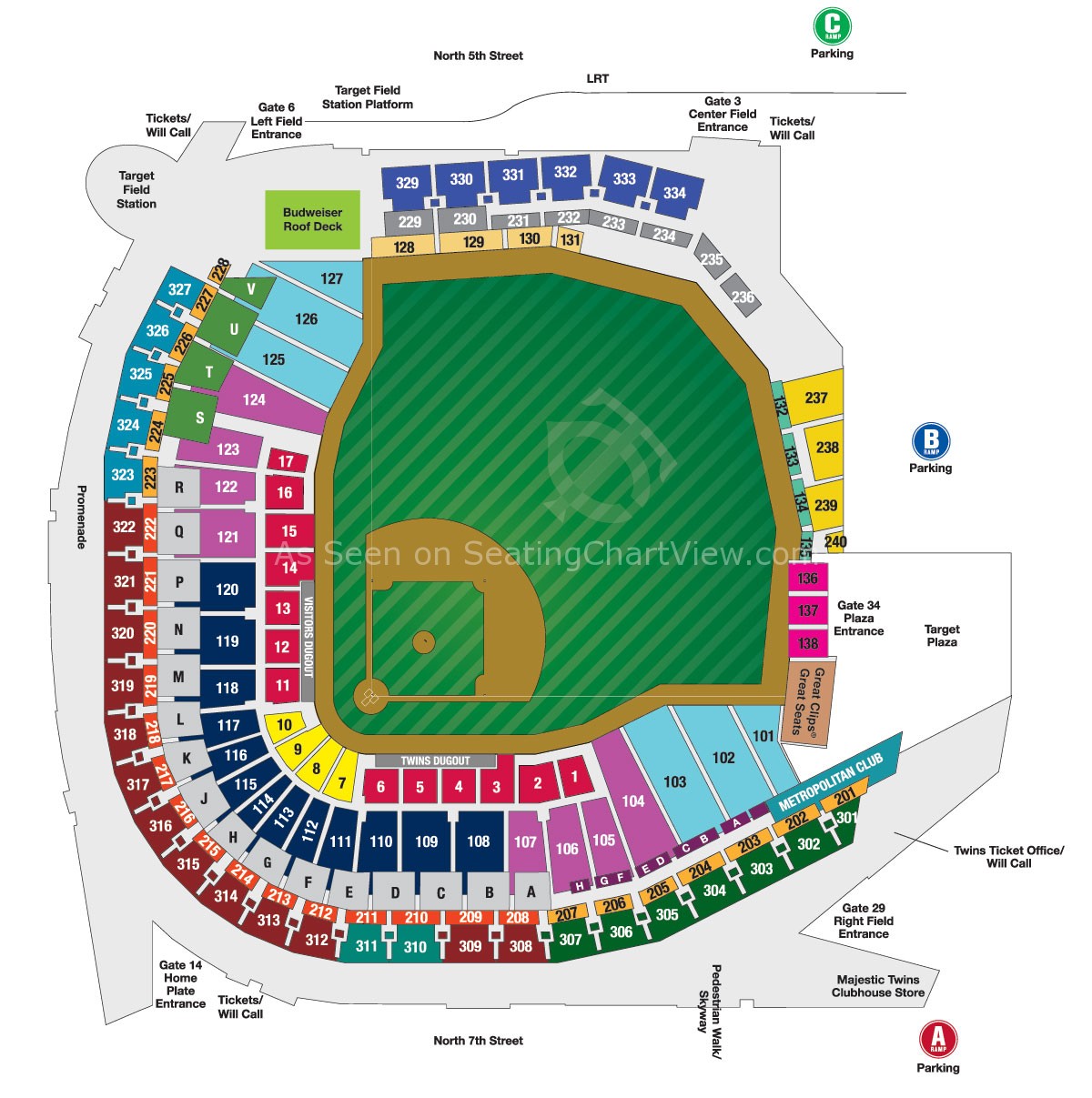
You’re standing on 7th Street in downtown Minneapolis, the limestone walls of the stadium rising up like a modern fortress of baseball, and you realize you have no idea where your seat actually is. It happens. Honestly, looking at a Target Field seating map for the first time is a bit like trying to read a topographical map of the Andes while someone yells "Go Twins!" in your ear. It’s dense. There are levels tucked under levels, limestone overhangs that block the sun (or the rain), and "Value" sections that aren't always a great value if you hate neck cramps.
Target Field is widely considered one of the best parks in the MLB, but it is compact. Built on a tiny 8.5-acre footprint—the smallest in the league—the architects had to get creative. That creativity means the "traditional" way you think about stadium layouts doesn't always apply here. If you just grab the cheapest ticket on a secondary market site without checking the specific geometry of the section, you might end up behind a massive green structural beam or staring at the back of the limestone "batter's eye" in center field.
The Secret Geometry of the Target Field Seating Map
Most people look at the map and see a standard horseshoe. That’s a mistake. The stadium is actually designed with a heavy "pitch" to keep fans closer to the action, but because it sits over an active interstate and a commuter rail station (Target Field Station), the angles are weirdly specific.
Take the Legends Club. These are sections 10 to 16, and on the map, they look like they’re just slightly elevated. In reality, they are cantilevered. You’re hanging over the lower bowl. If you're in the front row of the Legends Club, you are actually closer to the catcher than the people sitting in the back row of the expensive Dugout Box seats directly below you. It’s a spatial paradox that makes those seats some of the most coveted in the Twin Cities. But here's the kicker: if you go too far back in these sections, the overhang from the 200-level can make you feel like you're watching the game through a mail slot.
Then you have the Overlook and Catch areas. If you’re looking at the Target Field seating map in right field, you’ll see Section 101. It’s basically a shelf. You are sitting directly above the right-field wall. You can’t see the warning track. If a ball is hit right underneath you, you have to rely on the crowd’s reaction to know if it’s a double or a home run. Some people hate that lack of visibility. Others love being close enough to smell the grass and heckle the opposing right fielder.
Why the "Power Alley" Seats are Underrated
Everyone wants to sit behind home plate. Sure, sections 1 through 6 are great if you have the corporate account to pay for them. But the real pros—the season ticket holders who have been there since the Metrodome days—often pivot toward the power alleys.
Sections 103 to 105 (right field) and 123 to 127 (left field) offer a perspective that the TV cameras never capture. You see the breaking balls move. From the left-field side, specifically the Left Field Bleachers, you get a direct line of sight into the visitors' dugout. It's loud there. It's rowdy. It's where the home runs land.
- Section 126: High probability of a souvenir.
- The Porch: Located in right field, these seats are actually angled inward toward the pitcher's mound, saving you from the "tennis neck" of turning your head 45 degrees for three hours.
- Terrace Level: Sections 201-228. This is the "middle" tier. It’s the sweet spot for people who want a panoramic view of the Minneapolis skyline without feeling like they’re in orbit.
The skyline is actually a major part of the seating strategy. If you sit on the third-base side (the "home" side), you are looking away from the city. If you want that iconic view of the Target HQ and the skyscrapers glowing at sunset, you have to sit on the first-base side. Sections 105 through 114 are the prime spots for photographers and Instagram enthusiasts.
The Sun, the Rain, and the Limestone Overhangs
Minnesota weather is a chaotic neutral force. In April, it’s 38 degrees and snowing. In July, the humidity makes the air feel like warm soup. The Target Field seating map doesn't tell you where the shade is, but the geometry does.
The third-base side (left field line) gets the shade first. For a 6:10 PM start, sections 118 through 125 will be out of the direct glare of the sun while the people in the right-field bleachers are melting and squinting. If you’re bringing kids or someone sensitive to heat, the "home" side is the only choice.
Conversely, the Grandstand (sections 301-327) is high. Really high. It’s the 300 level. While the views are surprisingly good because of the steep rake of the seating, the wind up there can be brutal. Even on a nice day, a breeze coming off the prairies can make the 300 level feel ten degrees colder than the field. However, there’s a hidden gem here: the back rows of the 200 and 300 levels are often protected by the roof canopy. If the forecast calls for a "Minnesota Mist," those back rows are the driest spots in the house.
Budget Hacks and the "Standing Room" Myth
Let's talk about the Ballpark Access tickets. These are basically "get in the door" passes. On the map, they don't have a seat. You might think that's a raw deal. It isn't. Target Field was designed for wandering.
Between the Town Ball Tavern in left field and the Budweiser Roof Deck in right, there are hundreds of linear feet of drink rails. You can buy the cheapest ticket available, walk in, and stand directly behind the scout seats at field level. You’re ten feet away from a $300 seat, and you paid $20.
The "Top o' the Hoop" is another weird one. It’s the very top of the grandstand. You’re essentially on the roof. It sounds terrible, but the 360-degree views of the North Loop and the game are incredible. It’s basically a rooftop bar that happens to have a baseball game attached to it.
Navigating the Levels: A Quick Reference
- Field Level (100s): Close to the action. Section 114 is directly behind the Twins dugout. Section 107 is behind the visitors.
- Minnie & Paul's: Located under the big center-field sign. It’s a communal space with local food vendors. Great for people who get bored sitting in one spot.
- Delta SKY360 Club: These are the mid-level seats behind home plate. You get climate-controlled lounges. If you see "Club" on your ticket, you’re looking at luxury.
- The Tower: This is the vertical structure in the corner. It houses the elevators and stairs. If you have mobility issues, try to find seats near sections 112, 124, or 210 to stay near the main lift banks.
One detail many people miss on the Target Field seating map is the orientation of the seats in the corners. In many older parks, the seats face the outfield fence, meaning you have to twist your body to see the plate. At Target Field, the seats are "canted." They are physically turned toward the pitcher's mound. This is a small architectural detail that prevents massive back pain after nine innings.
What Most People Get Wrong About the Outfield
They think center field is the place to be. It isn't. The batter's eye—that big green wall that helps hitters see the ball—takes up a huge chunk of center field. There are actually very few seats there. Most of the "outfield" seating is pushed toward the foul poles.
Section 101 and 138 are the "corner" seats. They are often cheaper, but you’re staring at the foul pole. If you go just five sections toward the middle (like Section 134), the view improves by about 400% for an extra five or ten bucks.
Also, don't sleep on the Family Section. Section 311 is traditionally a no-alcohol zone. If you’re trying to avoid the "drunk guy screaming at the umpire" experience, that’s your sanctuary. It’s tucked away, but the sightlines are clean.
Practical Steps for Your Next Trip
Before you pull the trigger on those tickets, do three things.
First, check the game time. If it’s a day game, stay on the third-base side unless you want a tan. If it’s a night game, the first-base side offers the best city views.
Second, look at a 3D seat viewer. Most official sites have them now. Look for the "limestone pillars." In the 200 level, there are a few spots where a pillar might partially obstruct your view of the scoreboard. It’s rare, but it happens.
Third, consider your exit strategy. If you’re taking the Light Rail (Blue or Green line), you want to be on the left-field side of the stadium. That’s where the main plaza is. If you’re parking in Ramp A or B, the first-base side or home plate entrance is your fastest way out.
The Target Field seating map is more than just a grid of numbers; it’s a guide to the micro-climates and visual angles of one of the most intelligently designed spaces in professional sports. Whether you’re in the Kirby Puckett suite or standing at a drink rail in the 100-level concourse, there isn't really a "bad" seat—just seats that require a little more strategy than others.
Grab a Kramarczuk’s sausage, find your section, and just remember that in this park, the closer you are to the limestone, the closer you are to the soul of Minnesota baseball. Look for the "Minnie and Paul" sign in center field; when it lights up and they shake hands after a home run, you'll know exactly why you picked the seat you did.