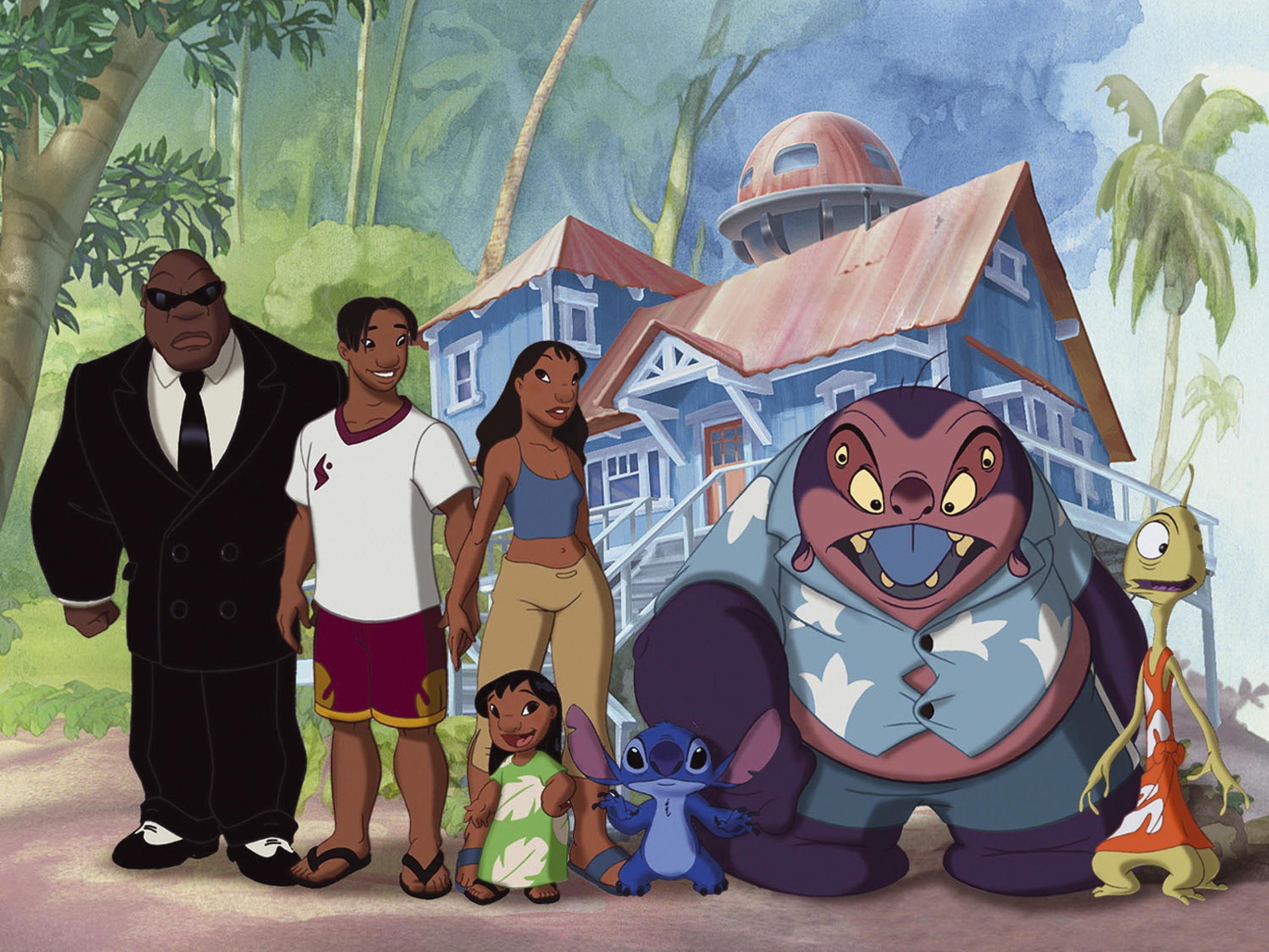
Honestly, if you grew up in the early 2000s, you probably didn't realize how heavy Lilo & Stitch actually was. We all came for the chaotic blue alien, but we stayed because the Lilo Stitch cartoon characters felt like real people—or at least, real aliens with very human problems. It wasn't just another "princess meets a talking animal" story. It was a messy, loud, and surprisingly deep look at grief and broken families.
Most Disney movies from that era had a clear-cut hero and a mustache-twirling villain. This movie? Not really. Even the "bad guys" were mostly just bureaucrats or scientists having a mid-life crisis.
Lilo Pelekai: The Weird Kid We All Needed
Lilo is, basically, the patron saint of weird kids everywhere. She doesn't fit in. She feeds peanut butter sandwiches to Pudge the fish because she thinks he controls the weather. She listens to Elvis and takes photos of tourists on the beach.
You’ve gotta realize that her "behavioral problems" aren't just for laughs. She’s a six-year-old girl processing the sudden death of her parents. When she tells Stitch "I remember everyone who leaves," it hits like a freight train. She wasn't just looking for a pet; she was looking for someone who wouldn't disappear on her.
The Realism of Nani Pelekai
Nani is arguably the most stressed-out character in Disney history. At eighteen, she’s trying to be a mother, a breadwinner, and a sister all at once. If you watch the movie as an adult, she’s the one you relate to most. You see her frantically cleaning when the social worker shows up, or the way she tries to keep it together while David is trying to cheer her up.
There’s a reason people still praise her character design. She looks like a real person who lives in Hawaii. She’s strong, she has realistic proportions, and she’s constantly exhausted. She isn't a magical savior; she's a teenager trying not to lose her only remaining family.
Experiment 626: More Than Just a Cute Alien
Stitch, or Experiment 626, was literally built to destroy. Jumba Jookiba created him with "super-intelligence" and the ability to "lift objects 3,000 times his own weight," but his most impressive feat was learning how to be a brother.
Stitch’s arc is basically a masterclass in nature vs. nurture. He starts as a creature of pure chaos who uses Lilo as a "human shield"—which, let's be real, was a pretty dark move for a Disney mascot—and ends up as the cornerstone of their ohana. He is one of the few Lilo Stitch cartoon characters who actually has to learn what love is from scratch.
The Support Crew: Jumba and Pleakley
Jumba and Pleakley are the ultimate "odd couple." Jumba is the self-proclaimed "evil genius" who is actually just a big softie who calls Lilo "Little Girl." He was the Lead Scientist of Galaxy Defense Industries before things went south.
Then you have Wendy Pleakley. He’s a Plorgonarian agent who is obsessed with Earth's "mosquitoes" and fashion. His dynamic with Jumba—especially when they're pretending to be human—is pure gold. They eventually become the weird uncles that the Pelekai household desperately needed to feel "whole" again.
The Villains and Rivals (Who Aren't All Bad)
- Captain Gantu: He’s a 20-foot-tall Shaelik who takes his job way too seriously. He isn't "evil" in the traditional sense; he's just a soldier following orders from the Grand Councilwoman. In the later series, he becomes a bumbling henchman for Dr. Hämsterviel, which is kinda sad but also hilarious.
- Cobra Bubbles: He looks like a Men In Black agent because he basically is one. While he’s the antagonist for much of the first film, his concern for Lilo is genuine. He’s a former CIA agent who just wants to make sure the kid is safe.
- Mertle Edmonds: The real villain. No, seriously. Every kid knew a Mertle. She’s the leader of the hula group who calls Lilo "Weirdlo." She’s the human personification of why Lilo felt so lonely before Stitch arrived.
The Cousins: Expanding the Ohana
When the TV show launched, we got introduced to the "cousins"—the other 625 experiments Jumba made before Stitch. Some of the standouts include:
- Reuben (625): He has all of Stitch's powers but only cares about making the perfect sandwich.
- Angel (624): Stitch's love interest who can turn people evil with her song (unless she sings it backward).
- Sparky (221): The first experiment they actually "rescued" and found a home for.
Why It Still Matters in 2026
The reason we're still talking about these characters is that they feel authentic. The movie doesn't sugarcoat how hard it is to stay together when the world is trying to tear you apart. The Hawaiian concept of ohana—that family means nobody gets left behind or forgotten—is the heartbeat of the entire franchise.
If you’re looking to dive back into the world of Hawaii and experiments, you can’t go wrong with rewatching the original 2002 film. It’s the foundation for everything.
Next Steps for the Ultimate Fan:
- Check out the TV series if you want to see the backstories for all 626 experiments.
- Look into the 2025 live-action remake to see how they've translated these iconic designs into a more realistic setting.
- Explore the "Stitch!" anime if you're curious about his adventures in Japan, which is a totally different vibe but still fun.