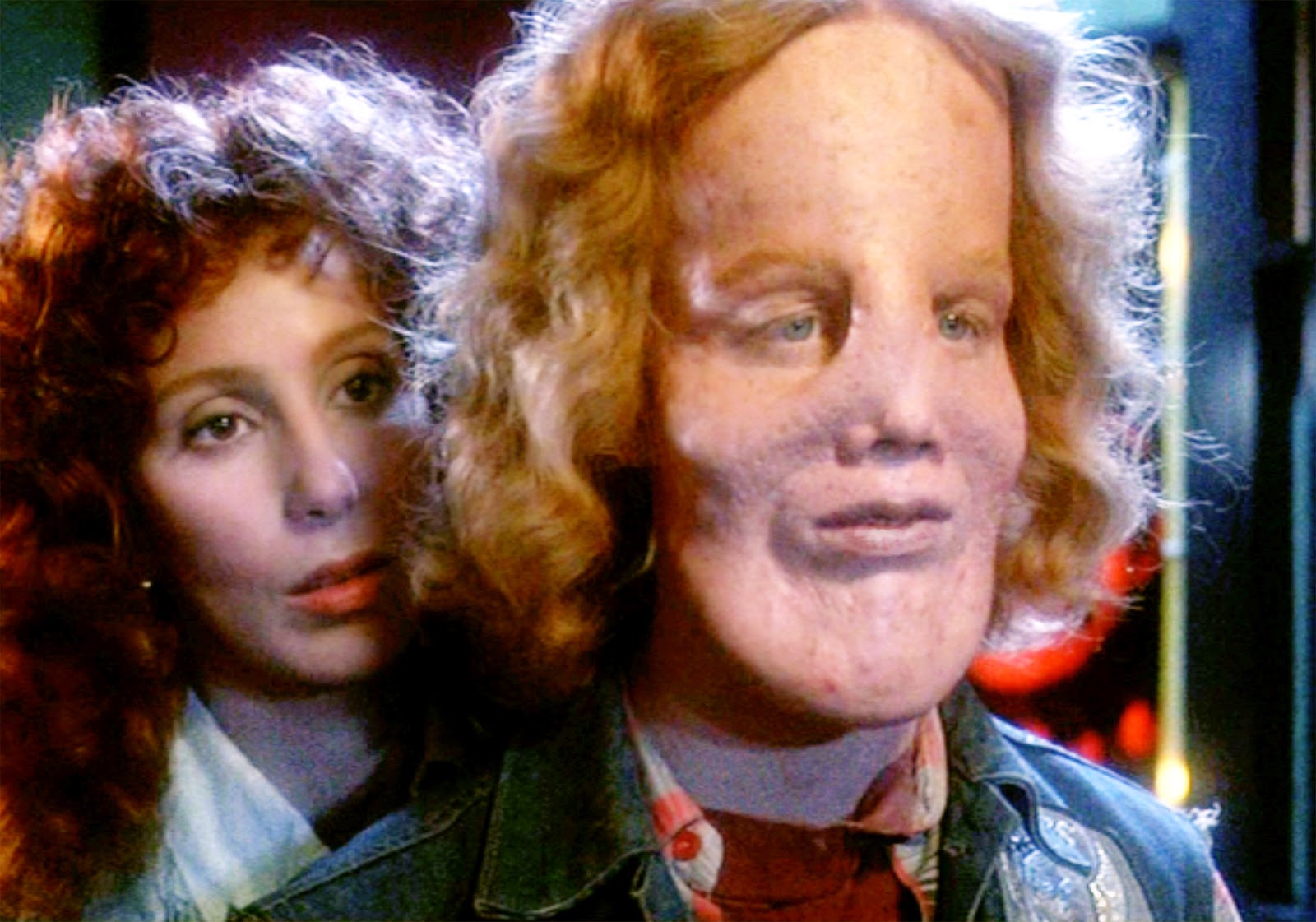
When you talk about the mask 1985 cast rocky connection, you’re usually diving into one of the most heartbreakingly honest films of the eighties. It’s funny how memory works. Some people hear "Rocky" and immediately think of Sylvester Stallone boxing in Philadelphia. But for a certain generation of moviegoers, Rocky means Rocky Dennis. He was the kid with craniodiaphyseal dysplasia, a bone disorder so rare it basically turned his face into a mask of thickened bone.
Eric Stoltz played him. Honestly, he was unrecognizable. He spent hours in the makeup chair every single morning just to become Roy L. "Rocky" Dennis. It wasn't just about the prosthetics, though. Stoltz captured this weird, beautiful mix of teenage vulnerability and "I don't give a damn" toughness that made the character feel real. He wasn't a victim. He was just a kid who liked cards, Bruce Springsteen, and motorcycles.
The movie, directed by Peter Bogdanovich, didn't just find success because of the makeup, which actually won an Academy Award for Michael Westmore and Zoltan Elek. It worked because the chemistry between the mask 1985 cast rocky and the supporting players felt lived-in. You had Cher playing Rusty, his mom. You had Sam Elliott as Gar, the father figure who rode with the Turks motorcycle club. It felt like a family, even if it was a messy, loud, leather-clad one.
Why Eric Stoltz almost didn't get the part
Casting the lead was a nightmare for Bogdanovich. He needed someone who could act through pounds of foam latex. If the actor was too stiff, the character became a statue. If they overacted, it looked like a cartoon. Stoltz wasn't the biggest name on the list at the time. In fact, he famously stayed in character the entire time he was on set. He even wore the mask when the cameras weren't rolling so the rest of the cast would get used to looking at him as Rocky, not Eric.
It worked.
The story goes that some people on the crew didn't even know what Eric Stoltz actually looked like until the wrap party. That's dedication. But it’s also what makes the performance hold up forty years later. You don't see a Hollywood star playing a "condition." You see a boy trying to figure out how to navigate high school, girls, and a ticking clock on his own life.
Cher and the Rusty Dennis transformation
Cher was already a star, but Mask proved she was a powerhouse actress. People forget that before this, she was still fighting for respect in the industry. Playing Rusty Dennis was a gamble. Rusty wasn't a "movie mom" in the traditional sense. She did drugs. She drank too much. She hung out with bikers. But she fought like a tiger for her son.
The real Rusty Dennis, who lived until 2006, was actually quite involved in the process. She famously had a bit of a prickly relationship with the production at times because she wanted the truth told, not a sanitized version. Cher captured that edge. There’s a scene where she’s screaming at the school board, demanding they let Rocky into a regular public school instead of a "special" one. It’s visceral. It’s the heart of the film.
The supporting cast: More than just background bikers
The mask 1985 cast rocky wouldn't be complete without the Turks. This wasn't some Sons of Anarchy stylized version of biker culture. It felt grittier. Sam Elliott, with that voice that sounds like a gravel road, played Gar. He provided the stability that Rusty couldn't always manage.
Then you have Laura Dern.
She plays Diana Adams, the blind girl Rocky meets at a summer camp where he’s a counselor. Their relationship is the emotional peak of the movie. It’s one of the few times in cinema where "love is blind" isn't a cliché. It’s a literal plot point that allows Rocky to be seen for who he is inside before his physical appearance is even a factor. Dern was young here, but you could already see the talent that would make her a legend.
- Sam Elliott (Gar): The ultimate cool-headed biker.
- Laura Dern (Diana): The girl who saw Rocky with her heart.
- Estelle Getty (Evelyn): Playing Rocky's grandmother, a role she took shortly before The Golden Girls turned her into a household name.
- Richard Dysart (Abe): Rocky’s grandfather, providing a grounded, suburban contrast to the biker lifestyle.
The tension behind the scenes
If you think the movie is emotional, the set was apparently a pressure cooker. Peter Bogdanovich and Cher did not get along. At all. He reportedly found her difficult to direct because she was "intuitive" rather than "technical." Cher, on the other hand, felt he didn't understand the character's soul.
They fought over everything. They fought over the music, too.
Bogdanovich wanted Bruce Springsteen's music in the film because the real Rocky Dennis was a massive fan. The studio, Universal, couldn't or wouldn't pay for the rights. They swapped it out for Bob Seger. Bogdanovich was so livid he actually sued the studio for $19 million. He lost, but he eventually released a Director's Cut years later that restored the Springsteen tracks. Honestly? It changes the whole vibe of the film. The Boss just fits Rocky's spirit better.
The real Rocky Dennis vs. the movie version
It’s easy to get lost in the mask 1985 cast rocky performances and forget there was a real kid. Roy L. Dennis was born in 1961. Doctors told his mother he wouldn't live past seven. He lived to be 16.
The movie is pretty accurate regarding his intelligence and his spirit. Rocky was an honors student. He really did have a collection of cards and stones. But Hollywood did do what Hollywood does. They shifted some timelines. For instance, the ending of the film, where Rocky dies peacefully in his sleep, is a bit of a simplification of the medical reality he faced.
Also, the real Rocky had an older brother, Joshua, who isn't in the movie. Filmmakers often trim family members to keep the focus tight on the mother-son dynamic. It makes for a better narrative, but it’s a bit of a bummer for the real-life family history.
Why the "Mask" still matters in 2026
We live in an era of CGI and digital de-aging. Looking back at Mask, you realize how much is lost when you don't have physical props and makeup. The fact that the mask 1985 cast rocky had to interact with a physical, tactile version of Rocky's face changed how they acted. You can see it in how Sam Elliott touches Stoltz’s shoulder or how Cher looks into his eyes through the layers of latex.
There's a weight to it.
It’s a story about the "other." In 1985, this was a massive hit because it challenged people to look past deformity. Today, that message still hits, but for different reasons. We’re so obsessed with "filtered" lives and perfect Instagram faces. Rocky Dennis is the antithesis of a filter. He is raw, permanent, and unapologetic.
Notable technical achievements of the production
- The Prosthetics: Michael Westmore designed a three-piece appliance. It had to be thin enough to allow Stoltz to move his facial muscles but thick enough to simulate bone growth.
- The Lighting: Cinematographer László Kovács had to light Stoltz carefully. If the light was too flat, the mask looked like rubber. They used shadows to give the face depth and realism.
- The Wardrobe: The biker vests and denim weren't just costumes. Many of them were aged and distressed to look like they’d seen a thousand miles of highway.
Practical steps for fans and collectors
If you're looking to dive deeper into the world of Rocky Dennis and the 1985 film, don't just stop at the streaming version.
Track down the Director's Cut. As mentioned, the Springsteen soundtrack is essential. It’s the way the film was intended to be seen. You can usually find it on physical media like Blu-ray or specialized boutique labels. The Seger version isn't bad, but the Springsteen version is the version.
Read "The Up and Down and Around" by Rusty Dennis. If you can find excerpts or interviews with the real Rusty, do it. She was a fascinating, flawed, and incredibly strong woman who survived way more than just the loss of her son. She outlived both of her children, which is a tragedy the movie only hints at.
Check out the makeup archives. For the film nerds, look into Michael Westmore’s books on movie makeup. He breaks down exactly how he built the Rocky Dennis face. It’s a masterclass in practical effects that still beats 90% of the digital effects we see today.
Visit the real Rocky's legacy. Rocky is buried at Forest Lawn Memorial Park in Cypress, California. It’s a quiet place where fans still occasionally leave small stones or cards, much like the ones he collected in the movie. It’s a reminder that while the mask 1985 cast rocky gave us a masterpiece, the real boy gave us the inspiration.
The film remains a staple of 80s cinema because it doesn't blink. It shows the pain, the biker brawls, the drug use, and the eventual loss. But mostly, it shows that having a "mask" doesn't mean you don't have a life. Rocky Dennis lived more in 16 years than most people do in 80. That’s why we’re still talking about him, and that’s why this cast remains one of the most respected ensembles of that decade.
To truly appreciate the film's impact, watch the scene where Rocky uses heat and cold to explain colors to Diana. It’s a perfect distillation of the movie's soul. Stoltz uses his hands and his voice to bridge a gap that physical sight couldn't cross. That’s the "Mask" legacy in a nutshell—finding a way to connect when the world tells you it’s impossible.