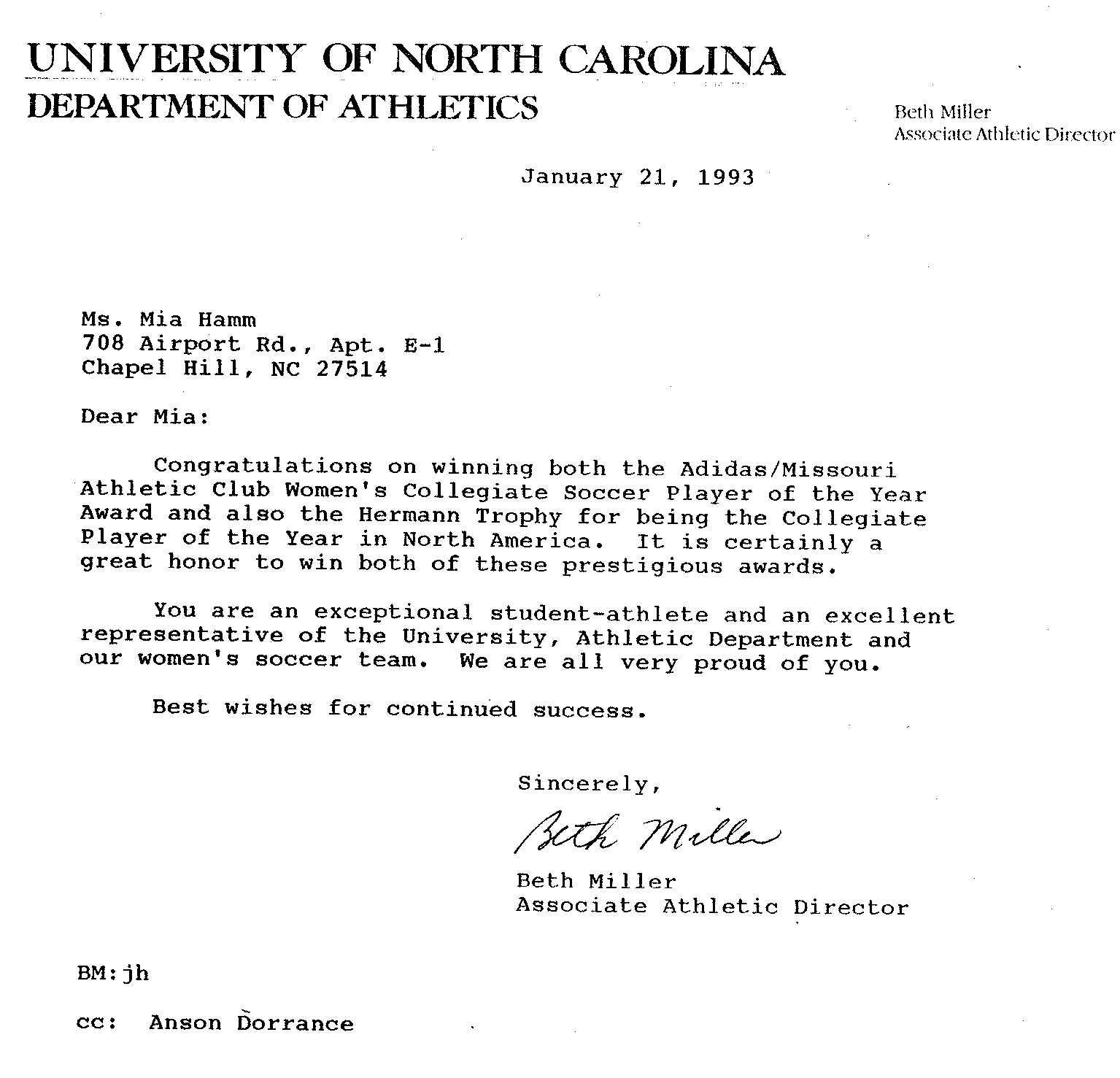
When you think of Chapel Hill, you probably think of Michael Jordan’s tongue-wagging dunks or the light blue jerseys that look good on literally everyone. But there’s a different kind of greatness that lived on the Fetzer Field grass. Honestly, if you want to talk about the most dominant era any college athlete has ever had, you’re talking about Mia Hamm at UNC. It wasn't just a winning streak. It was a complete takeover of the sport.
Most people know Mia as the face of the 1999 World Cup, the Nike commercials, and the Gatorade ads. But the "monster" she became was built in North Carolina. Between 1989 and 1993, she didn't just play soccer; she dismantled the competition. She finished her career with a 92-1-2 record. Just think about that for a second. In four years of college ball, she lost one single game.
The Numbers That Look Like Video Game Stats
People throw the word "GOAT" around way too much these days. With Mia, it’s actually a math problem. By the time she graduated in 1994, she had racked up 103 goals and 72 assists. That’s 278 total points. Basically, she was involved in a goal every time she stepped onto the pitch.
Her 1992 season was particularly ridiculous. She set the NCAA single-season record with 97 points. Most strikers would kill for 20 points in a season. Mia was nearly touching 100. It's kinda funny looking back because she was already a world champion before she even finished her junior year. She redshirted in 1991 to go win the first-ever Women’s World Cup in China. She came back to Chapel Hill and somehow played even better.
You’ve got to realize the culture she was in. Coach Anson Dorrance created what he called the "Competitive Cauldron." It was this intense, borderline-obsessive environment where every single sprint, tackle, and shot was tracked and ranked on a public board. If you were at the bottom, everyone knew. Mia wasn’t just at the top; she was the one driving the intensity.
Why Mia Hamm at UNC Still Matters Today
It’s easy to look at the past through rose-colored glasses, but the impact of those years at UNC shaped the entire infrastructure of women's soccer in the United States. Before Mia, the sport was a niche collegiate activity. By the time she left, it was a brand.
The University of North Carolina has won over 20 NCAA titles in women's soccer, but the Hamm years felt different. She was the first Tar Heel to win the Honda Broderick Cup as the top female athlete in the entire country. In 2003, when the ACC celebrated its 50th anniversary, they named the top 50 athletes in conference history. Mia Hamm and Michael Jordan were named the greatest. That’s the tier we’re talking about.
The Secret Sauce of the "Competitive Cauldron"
If you ask Mia about those years, she doesn't lead with the goals. She talks about the sweat. There’s a famous quote by Dorrance that Mia used as the North Star for her career: "The vision of a champion is someone who is bent over, drenched in sweat, at the point of exhaustion, when nobody else is watching."
She lived that.
During her time in Chapel Hill, she developed a "growth mindset" long before it was a corporate buzzword. She wasn't satisfied with being the fastest player on the field—which she usually was. She wanted to be the most clinical.
- Four NCAA Championships: 1989, 1990, 1992, and 1993.
- Jersey Retirement: Her #19 was retired in 1994, a rare honor at UNC.
- The 1991 Gap: Her redshirt year proves how much she sacrificed for the national team while still being a "student."
She was a political science major who spent her weekends turning elite defenders into statues. It’s sort of wild to think about her rushing Franklin Street after basketball wins just like any other student, considering she was already a global icon in the making.
The Legacy Beyond the Box Score
Recently, in May 2025, Mia returned to campus to deliver the Spring Commencement address. Standing in Kenan Stadium, she told the graduates that Carolina prepared her to define her own legacy. It wasn't just about the trophies; it was about the resilience.
She hasn't just sat on her laurels either. The Mia Hamm Foundation, which she started to honor her brother Garrett, does incredible work for bone marrow research and women's sports. The "Carolina way" isn't just a marketing slogan for her; it’s how she’s lived the last thirty years.
Honestly, if you're a young player today looking for a blueprint, you don't look at the Instagram highlights. You look at the 1992 game logs. You look at a player who refused to let her team lose. She didn't just play for UNC; she was the standard.
Actionable Takeaways from Mia’s Tenure
If you want to channel that "Mia at UNC" energy in your own life or sport, here is what actually works:
- Track your progress relentlessly. Don't just "practice." Measure your success. The "Competitive Cauldron" worked because the data didn't lie.
- Sacrifice for the bigger stage. Mia redshirted a year of her prime college career to help build the USWNT. Sometimes you have to step away from one success to build a greater one.
- Find your "when nobody is watching" moment. Greatness isn't found in the stadium lights; it's found in the extra sprints at 6:00 AM on a Tuesday.
- Value the assist. Even as the world's best scorer, Mia's assist record (72) shows she was just as focused on making her teammates better.
Whether you're a die-hard Tar Heel or just a fan of excellence, the story of Mia Hamm at UNC is the ultimate proof that dynasties aren't born—they're built, one sweat-drenched practice at a time. To truly understand the history of American soccer, you have to start on the fields of Chapel Hill.