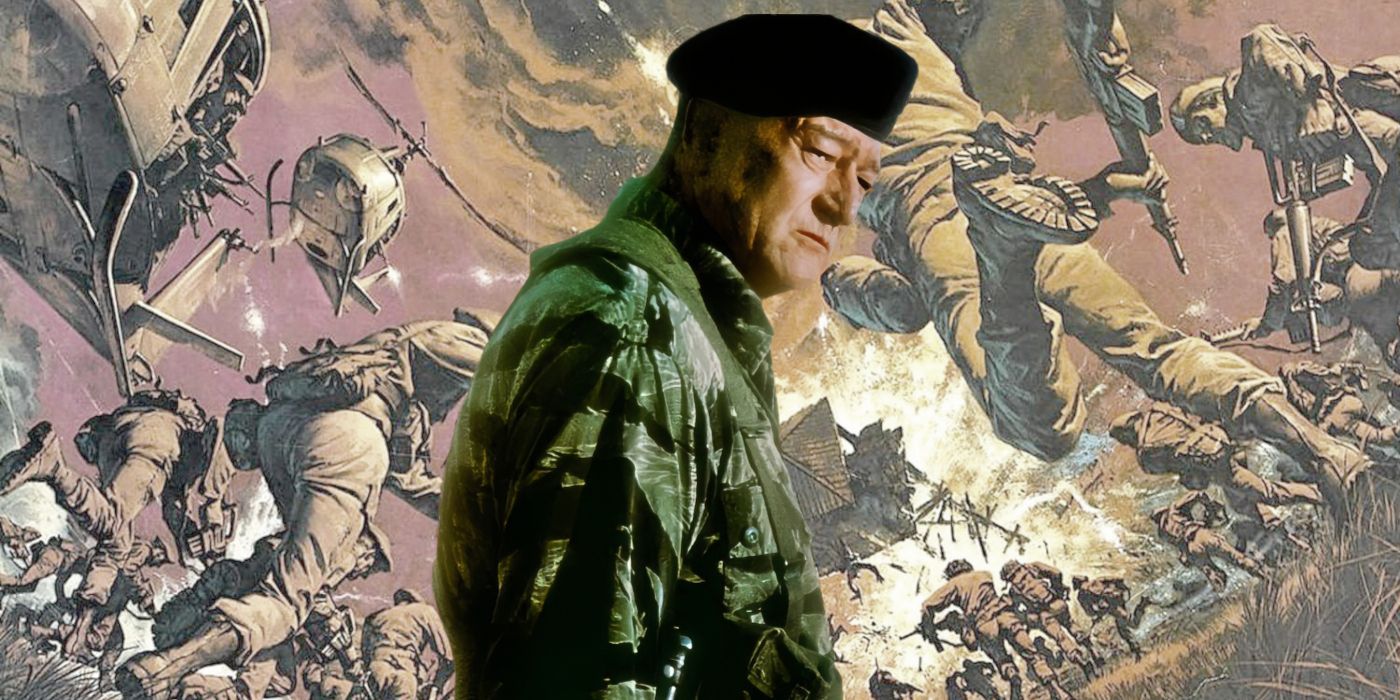
In the summer of 1968, the heat in America wasn't just coming from the sun. The country was basically tearing itself apart over the Vietnam War. Then, right in the middle of the chaos, John Wayne dropped a movie called The Green Berets. It wasn't just a film; it was a loud, unapologetic political statement. Honestly, it might be one of the most polarizing things ever to come out of Hollywood.
People either loved it or absolutely loathed it. There was no middle ground.
The Letter to LBJ and the Secret Deal
Most folks don't realize how much the Duke had to hustle to get this made. He didn't just walk onto a set. He actually wrote a personal letter to President Lyndon B. Johnson in 1965. Wayne basically told him that the American public needed to see why the U.S. was over there. He wanted to show the "good guys" fighting the "bad guys" in a way that felt like his old Westerns.
LBJ said yes. But there was a catch.
The Pentagon gave Wayne full military cooperation—helicopters, tanks, the works—but they demanded total script approval. They weren't about to let a Hollywood star show anything that made the Army look bad. This is why the movie feels so different from the Robin Moore novel it’s based on. The book was gritty and sortta cynical about the "dirty" side of unconventional warfare. The movie? It’s a recruitment poster.
Why Critics Absolutely Mauled It
If you look at the reviews from '68, they are brutal. The legendary Roger Ebert didn't hold back, calling it "cruel and dishonest." He wasn't the only one. Many critics felt that making a "cowboys and Indians" style movie about a war as messy as Vietnam was just... well, offensive.
But here is the weird part: audiences didn't care what the critics thought.
The Green Berets was a massive box office hit. It raked in over $32 million on a $7 million budget. While protestors were picketing theaters, people were lining up around the block to see the Duke wear that iconic headgear. It's a classic example of the "silent majority" showing up even when the media is screaming the opposite.
That Hilarious Sunset Gaffe
You can't talk about this movie without mentioning the ending. It’s legendary for all the wrong reasons. In the final scene, John Wayne and a young boy walk along the beach as the sun sets over the ocean. It’s supposed to be a touching, patriotic moment.
Except for one thing.
The movie is set in Vietnam, where the ocean is to the East. You can't see the sun set over the water in Da Nang. You just can't. It’s physically impossible. They filmed the whole thing at Fort Benning, Georgia, and apparently, nobody bothered to check a map before they rolled the cameras on that final shot. It’s the kind of mistake that still makes history buffs and veterans chuckle today.
The Real Green Beret Who Inspired Kirby
While the movie is full of Hollywood tropes, the lead character, Colonel Mike Kirby, was actually loosely based on a real-life badass: Lauri Törni (also known as Larry Thorne).
Thorne's life was wilder than any script. He was a Finnish officer who fought the Soviets in WWII, then joined the U.S. Army Special Forces. He was a legend among the real Green Berets. Sadly, he went MIA in Vietnam in 1965, just as the movie was starting to take shape. Wayne wanted to honor that kind of "old school" soldier, even if the film ended up being more about mythology than reality.
A Legacy That Refuses to Die
Why do we still talk about The Green Berets? Basically, because it represents a turning point in how we look at war on screen. After this, Vietnam movies got darker and more critical—think Platoon or Apocalypse Now.
John Wayne’s film was the last of its kind. It was the final gasp of the "Greatest Generation" style of filmmaking applied to a war that didn't fit that mold. You’ve got to respect the Duke’s conviction, even if you think the movie is a total mess. He risked his reputation and his money to back the troops when nobody else in Hollywood would.
How to Re-watch (or Watch for the First Time)
If you’re going to dive into The Green Berets today, you have to watch it as a historical artifact. Don't go in expecting a realistic war documentary.
- Look for the Pine Trees: Keep an eye on the background. Since it was filmed in Georgia, you’ll see way more pine trees than tropical jungle.
- George Takei's Cameo: Yes, Sulu from Star Trek is in this. He plays a South Vietnamese officer, and he’s actually one of the better parts of the cast.
- The Propaganda Factor: Try to spot the moments where the script feels like it was written by a committee at the Pentagon. It usually happens during the long speeches about why the U.S. is there.
To truly understand the impact of this film, it's worth reading Robin Moore’s original book alongside a viewing. The contrast between the two tells the real story of how the 1960s changed America. You'll see exactly where the "Hollywood version" diverged from the "ground truth" of the Special Forces.
Next time you see a modern war movie, remember that The Green Berets paved the way—mostly by showing everyone else what not to do if they wanted to stay on the good side of the critics. It remains a fascinating, flawed, and deeply American piece of cinema history.
Practical Insight for Film Buffs: If you want to see the real impact of the movie's production, research the "Vietnam Villages" built at Fort Benning. They were so accurate that the Army actually used them to train soldiers for years after the film crew left town.
Dive deeper into the controversy: Check out the archived correspondence between John Wayne and the LBJ library. It reveals a level of celebrity-government collaboration that would be almost impossible in today's political climate.