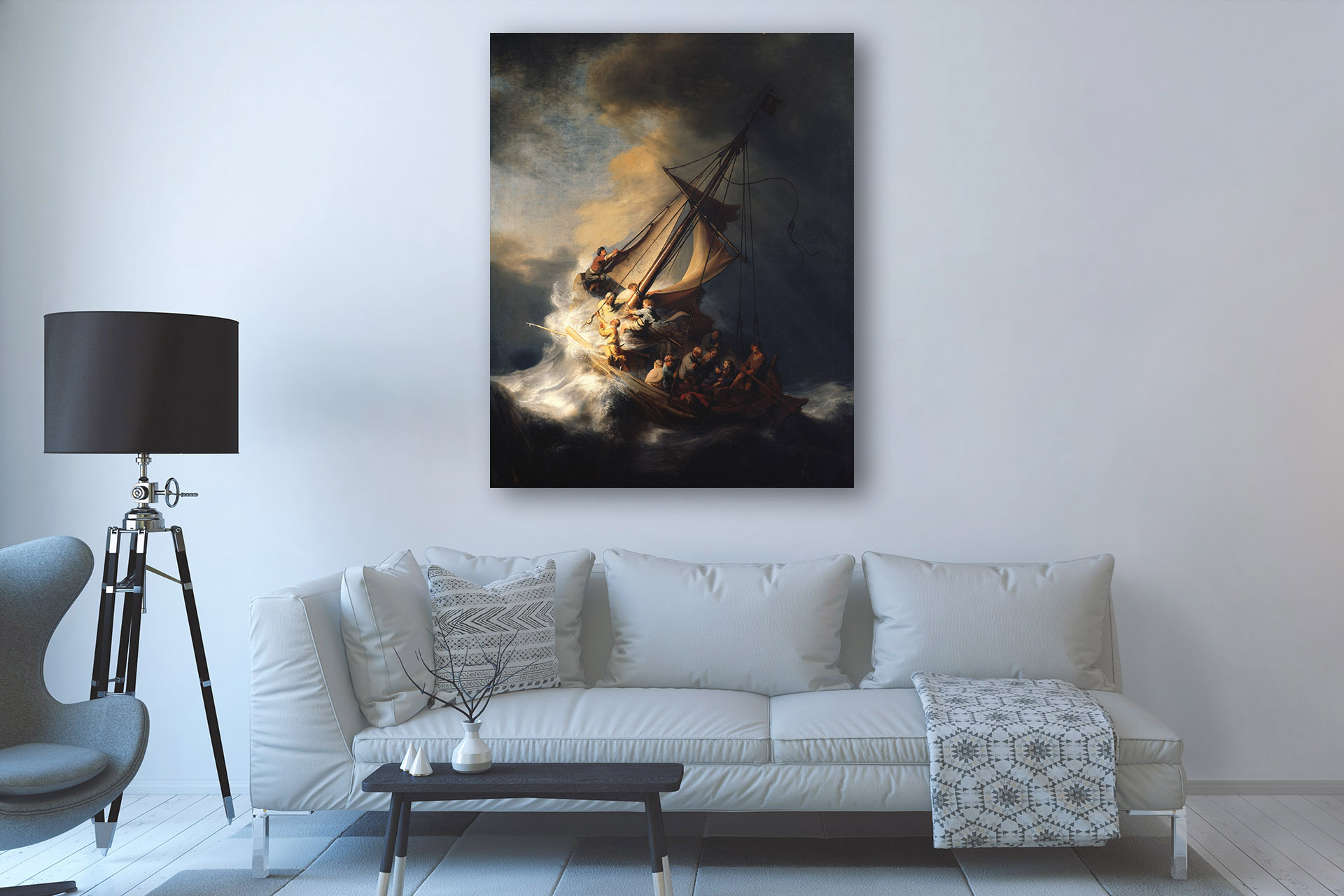
March 18, 1990. 1:24 a.m. Two guys in fake police uniforms buzz the side door of the Isabella Stewart Gardner Museum in Boston. They tell the young guard, Rick Abath, they’re investigating a "disturbance." He lets them in. Big mistake. Within minutes, the guards are duct-taped to a steam pipe in the basement, and the thieves have 81 minutes of uninterrupted access to some of the greatest art on the planet. They didn't take the most expensive stuff, strangely. But they did take The Storm on the Sea of Galilee Rembrandt, the Dutch master’s only known seascape.
They literally cut it out of its frame.
Imagine that for a second. This masterpiece, painted in 1633 when Rembrandt was only 27 and riding high in Amsterdam, was sliced from its wood with a blade. It hasn't been seen in public since. Today, if you walk into the Dutch Room at the Gardner Museum, you'll see a ghost. A heavy, gilded frame hangs empty on the wall, a "poignant reminder," as the museum calls it, of what’s missing. It’s been 36 years. The reward is $10 million. And honestly? Most experts think it might be gone for good, or stashed in some mobster’s attic in Connecticut.
Why the Storm on the Sea of Galilee Rembrandt is a big deal
It’s not just "another old painting." This is Rembrandt van Rijn at his most theatrical. Most of his work is about faces, shadows, and quiet, heavy moments. But here? It’s pure chaos.
The composition is built on a sharp diagonal. The boat is tilted at a terrifying angle, nearly vertical, as a massive wave crashes over the bow. It’s the biblical story from the Gospel of Mark where Jesus calms the storm. But Rembrandt doesn't focus on the "calm" part yet. He focuses on the "we’re all going to die" part.
The Mystery of the 14th Man
If you count the people in the boat, you’ll notice something weird. There’s Jesus. There are the twelve disciples. That makes 13. But there are actually fourteen figures in the painting.
Who’s the extra guy? It’s Rembrandt.
Basically, he painted himself into the scene. He’s the one near the middle, holding onto a rope with one hand and clutching his hat with the other, looking straight at us. It’s like he’s asking, "What would you do in this storm?" It’s a classic Baroque move—blurring the line between the holy story and the viewer’s reality.
The Detail You Probably Missed
Look at the disciples. They aren't all praying. In fact, most of them are losing their minds.
- One guy is leaning over the side of the boat, clearly seasick and retching into the water.
- Another is desperately trying to fix a torn sail that’s flapping in the wind.
- Another is screaming at Jesus, who is sitting in the back, looking suspiciously chill for someone about to capsize.
Rembrandt was a master of "human" moments. He didn't want to paint plastic saints; he wanted to paint terrified fishermen. The contrast between the dark, murky water on the right and the burst of light hitting the waves on the left is classic chiaroscuro. It’s a visual tug-of-war between hope and total disaster.
The Heist: A Comedy of Errors or a Masterstroke?
The 1990 theft is the stuff of movies. Seriously, Netflix made a whole documentary about it. But the more you look at the details, the more "unprofessional" it seems.
The thieves spent over an hour inside. That’s an eternity in heist time. They bypassed the most valuable painting in the room—Titian’s The Rape of Europa—which many consider the finest Renaissance painting in America. Instead, they took a Napoleonic eagle finial and a Chinese beaker. Kinda strange, right?
The FBI has chased 30,000 leads. They’ve looked at the Irish Republican Army (IRA), local Boston mobsters like Robert Gentile, and even "inside job" theories involving the guards. In 2013, the FBI actually announced they knew who did it, pointing toward a criminal organization in the Mid-Atlantic and New England. But they didn't name names. And they didn't find the art.
Where is it now?
There are three main theories people talk about in art circles:
- The Black Market Trophy: A wealthy, "Dr. No" type collector bought it and has it in a basement somewhere. (Unlikely—you can’t show this painting to anyone without getting arrested).
- The Get-Out-of-Jail-Free Card: It’s being held by a criminal organization to be used as leverage with the feds if a high-ranking member gets caught for a different crime.
- The Tragedy: Because it was cut from the frame and rolled up (which is terrible for old oil paint), it might have cracked, rotted, or been destroyed out of fear when the heat got too high.
The Current Status in 2026
As of right now, the Isabella Stewart Gardner Museum is still waiting. They recently finished a massive "floor-to-ceiling" restoration of the Dutch Room. They even restored the empty frames. They are ready for the storm on the sea of galilee rembrandt to come home tomorrow.
The $10 million reward is still on the table. No questions asked. If you have a lead that leads to the physical recovery of the art in "good condition," you're rich. Simple as that.
The museum’s director of security, Anthony Amore, has spent decades on this. He’s obsessed. He points out that stolen masterpieces often show up a generation later. Wives become ex-wives. People get old and want to clear their conscience. Or someone dies, and their kids find a weirdly famous-looking painting behind a false wall.
Actionable Insights for Art Lovers
If you’re fascinated by this mystery, you don’t have to just sit and wait for the news.
- Visit the Gardner Museum: It’s in Boston. Seeing the empty frames in person is actually more emotional than seeing the art. It’s a shrine to what’s lost.
- Report Leads: If you actually have real info (not just a "hunch"), the museum has a dedicated email:
reward@isgm.org. - Study the High-Res Digital Versions: Since the physical painting is gone, the museum has made high-resolution scans available. You can zoom in and see Rembrandt’s signature on the rudder.
- Watch the Evidence: Keep an eye on the FBI’s National Stolen Art File. If it ever surfaces, that’s where the "found" notice will hit first.
The storm on the sea of galilee rembrandt remains the "Holy Grail" of the art world. It’s a painting about surviving a storm, currently stuck in a 36-year-long storm of its own. Whether it’s in a climate-controlled vault or a damp basement in Southie, it’s still the most famous missing person in Boston history.
To help keep the search alive, you can share the high-definition images provided by the Gardner Museum’s digital archives. Documenting and discussing the piece ensures that even if the physical canvas is hidden, its cultural impact isn't forgotten. Familiarizing yourself with the 13 stolen works also helps—often, items from the same heist are recovered together.