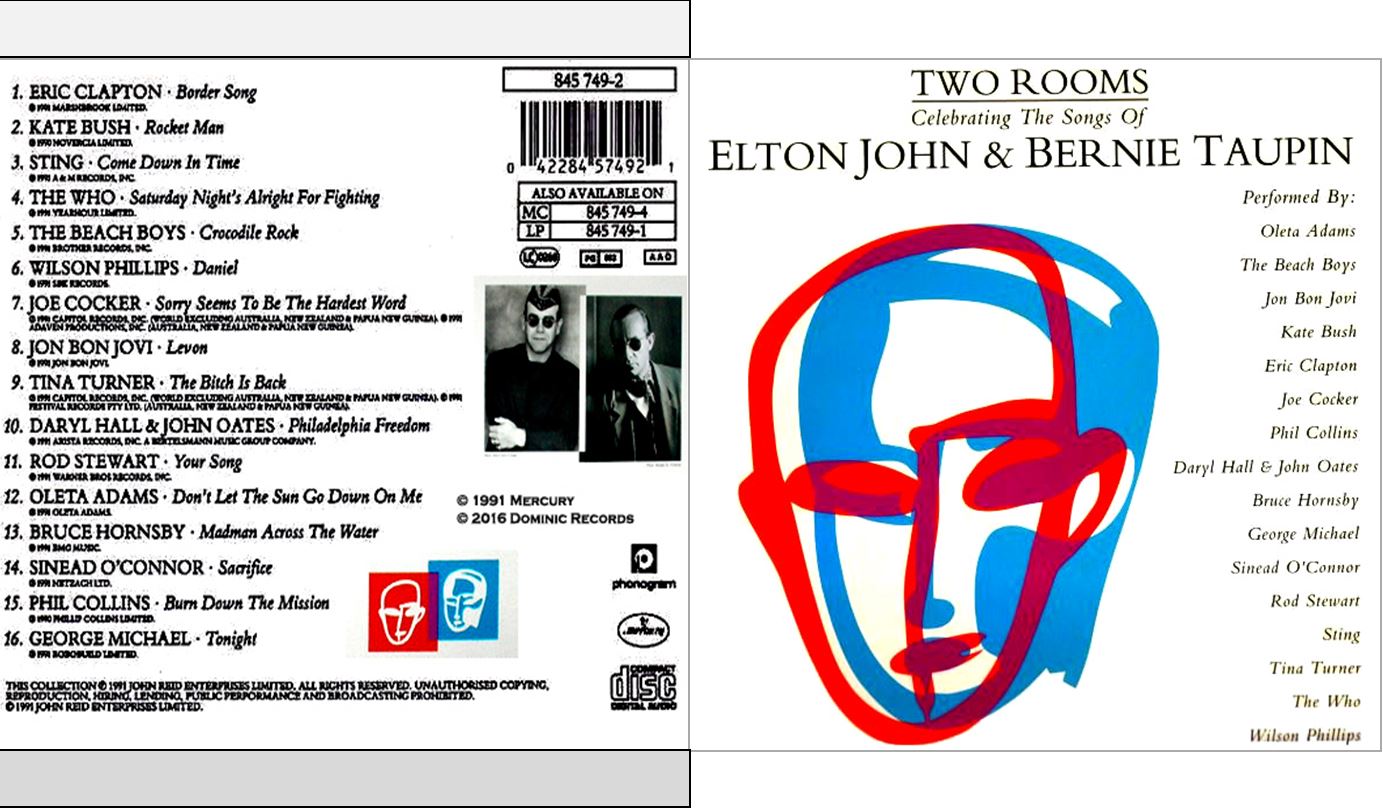
It was 1991. Elton John was already a legend, but he was also at a crossroads, having recently become sober and found a new sense of purpose. Then came this massive project. Two Rooms Celebrating the Songs of Elton John wasn't just another greatest hits compilation thrown together by a label to squeeze out a few more bucks. It was a weird, sprawling, star-studded experiment.
Honestly, tribute albums are usually a mess. You get a couple of decent covers and a whole lot of filler where artists try way too hard to sound like the original. But this one? It felt different. It celebrated the "Two Rooms"—one for Elton, one for Bernie Taupin. That songwriting partnership is arguably the most successful in rock history, and this 1991 release was the first time the industry really stopped to say, "Wait, look at the sheer volume of what these two guys have actually done."
It's a bizarre mix of 16 tracks. You’ve got heavy metal icons, soul divas, and indie darlings all trying to figure out how to navigate Bernie’s dense lyrics and Elton’s deceptively complex piano melodies.
Why the "Two Rooms" Concept Still Matters Today
Most people forget that Elton and Bernie rarely sat in the same room to write. That’s the whole point of the title. Bernie would mail a lyric sheet—sometimes stained with coffee or whatever else—and Elton would sit at a piano and find the melody in about twenty minutes. He never asked for edits. He just played what the words felt like.
This album captured that separation. By having other artists interpret the songs, it highlighted the versatility of the writing. When you hear Sinéad O’Connor strip "Sacrifice" down to its bare bones, you realize it’s not just a 1980s adult contemporary hit. It’s a devastating poem about the end of a marriage.
You've probably heard the Eric Clapton version of "Border Song" on the radio without even realizing it was from this specific project. It reached number five on the Billboard Album Chart. That’s insane for a tribute record. It happened because the 1990s were a time when "legacy" artists were being rediscovered by a younger generation, and Two Rooms was the bridge.
The Hits and the Weird Misses
Not every track on Two Rooms Celebrating the Songs of Elton John is a masterpiece. Let's be real.
Some of it feels very "of its time." The Beach Boys doing "Crocodile Rock" sounds exactly how you’d imagine—heavy on the nostalgia but maybe a little too safe. But then you have Sting taking on "Come Down in Time." It’s moody. It’s jazz-adjacent. It actually improves on the original in some ways because it leans into the loneliness of the lyrics.
The real standout, for many, remains George Michael’s live version of "Tonight." It’s vulnerable. He doesn’t try to out-sing Elton; he just inhabits the song. It reminds us that Elton’s music isn’t just about the glitter and the glasses—it’s about the craftsmanship.
Then there’s Guns N' Roses doing "The Bitch Is Back." It shouldn't work. Axl Rose screaming about being a bitch? It sounds like a disaster on paper. But they lean into the glam-rock energy that Elton always possessed. It’s a reminder that Elton was, in his heart, a rocker. He wasn't just the guy playing "Can You Feel the Love Tonight" at a Disney premiere.
The Documentary That Most People Missed
While the CD was the big seller, there was also a film component. The Two Rooms documentary gave us a rare look at the archive. We saw the hand-written lyrics. We saw the footage of them at Chateau d'Herouville.
It’s one thing to hear the music, but seeing the process? That's where the value is. The film features interviews with the artists on the album, but the real meat is the dialogue between Elton and Bernie. They talk about their "marriage" without the sex. It’s a creative bond that has outlasted almost every other partnership in the industry.
If you’re a songwriter, you need to watch this. It de-mystifies the process. There is no "waiting for the muse." It’s work. Bernie writes. Elton composes. They don't overthink it. This album was a celebration of that blue-collar approach to art.
The Impact on the 90s Music Scene
In 1991, the world was shifting. Grunge was about to explode. Synthesizers were becoming less cool. Somehow, Two Rooms fit into that transition. It showed that good songs could survive any arrangement.
Whether it was Joe Cocker's soulful growl on "Sorry Seems to Be the Hardest Word" or Tina Turner's powerhouse "The Bitch Is Back" (yes, there were two versions of that song circulating around the project’s orbit), the album proved Elton’s catalog was indestructible.
It also set the stage for Elton’s massive 90s comeback. Without the critical respect garnered by Two Rooms, would he have been the first choice for The Lion King? Maybe not. This project reminded the gatekeepers of culture that Elton John was a pillar of the Great American (and British) Songbook.
A Track-by-Track Reality Check
Let's look at the variety here because the sequencing is honestly a bit chaotic.
- Eric Clapton - "Border Song": Very gospel, very safe, very Clapton. It’s the "dad rock" anchor of the album.
- Kate Bush - "Rocket Man": This is the weirdest track. She turned it into a reggae-infused art-pop experiment. People either love it or think it’s a travesty. There is no middle ground.
- The Who - "Saturday Night's Alright for Fighting": It’s loud. It’s aggressive. It makes total sense because Pete Townshend and Elton come from the same era of British rock explosion.
- Hall & Oates - "Philadelphia Freedom": Surprisingly funky. They leaned into the soul roots of the song.
- Rod Stewart - "Your Song": It’s fine. It’s Rod Stewart. He’s done a million covers, and this is one of them. It doesn't take risks, but it's a solid vocal performance.
The diversity of the lineup—from Wilson Phillips to Bon Jovi—is a testament to how wide Elton’s net was cast. You don't get that kind of cross-genre appeal anymore. Everything is so siloed now. Back then, everyone just agreed that Elton was the guy.
The Legacy of the Tribute
If you go back and listen to Two Rooms Celebrating the Songs of Elton John today, you’ll notice the production sounds very 1991. The drums are big, and there’s a lot of reverb. But the songs? They’re timeless.
It paved the way for future tribute projects like Revamp and Restoration in 2018, where artists like Lady Gaga and Chris Stapleton took their turns. But those later albums feel a bit more "corporate." They’re polished to a mirror finish. Two Rooms has a bit of grit to it. It feels like a moment in time where these artists were genuinely excited to pay their respects.
It’s also a reminder of Bernie Taupin’s genius. He is the invisible man of rock and roll. People often credit Elton with the emotion of the songs, but the lyrics are where the stories live. "Skyline Pigeon," "Bernie and the Jets," "Goodbye Yellow Brick Road"—these are cinematic narratives. The album forces you to listen to the words because the voices are different. You stop focusing on Elton’s flamboyant persona and start focusing on the poetry.
How to Experience "Two Rooms" Today
If you want to actually "celebrate" these songs properly, don't just put the album on shuffle. You have to understand the context.
- Listen to the original Elton versions first. Remind yourself of the baseline. Notice how Elton’s piano is the engine of the song.
- Watch the documentary. It’s available in various corners of the internet and on physical media. It provides the "why" behind the "what."
- Pay attention to the lyrics. This is a Bernie Taupin appreciation project as much as it is an Elton John one. Read the liner notes if you can find a physical copy.
- Compare the eras. Look at how Kate Bush reimagined "Rocket Man" compared to how Pnau did "Cold Heart" decades later. It shows the evolution of the "Elton Sound."
The biggest takeaway from this 1991 experiment is that the "Two Rooms" weren't a barrier; they were a filter. By working separately, Elton and Bernie created a space where the music could breathe. This tribute album proved that those songs could live in anyone's house, not just the two rooms where they were born.
It remains a high-water mark for the tribute genre because it didn't try to reinvent the wheel—it just showed how well the wheel was made in the first place. Whether you're a die-hard fan or just someone who knows "Tiny Dancer" from the movies, this collection is the definitive look at what happens when world-class songwriting meets world-class interpretation.
To truly appreciate the depth of this collection, seek out the rare B-sides and the live performances from the televised special that accompanied the release. The live energy of artists like Bonnie Raitt and Joe Cocker performing these tracks in an intimate setting adds a layer of soul that the studio recordings sometimes miss. Exploring these lesser-known recordings offers a more complete picture of the impact Elton and Bernie had on their peers across the entire musical spectrum.