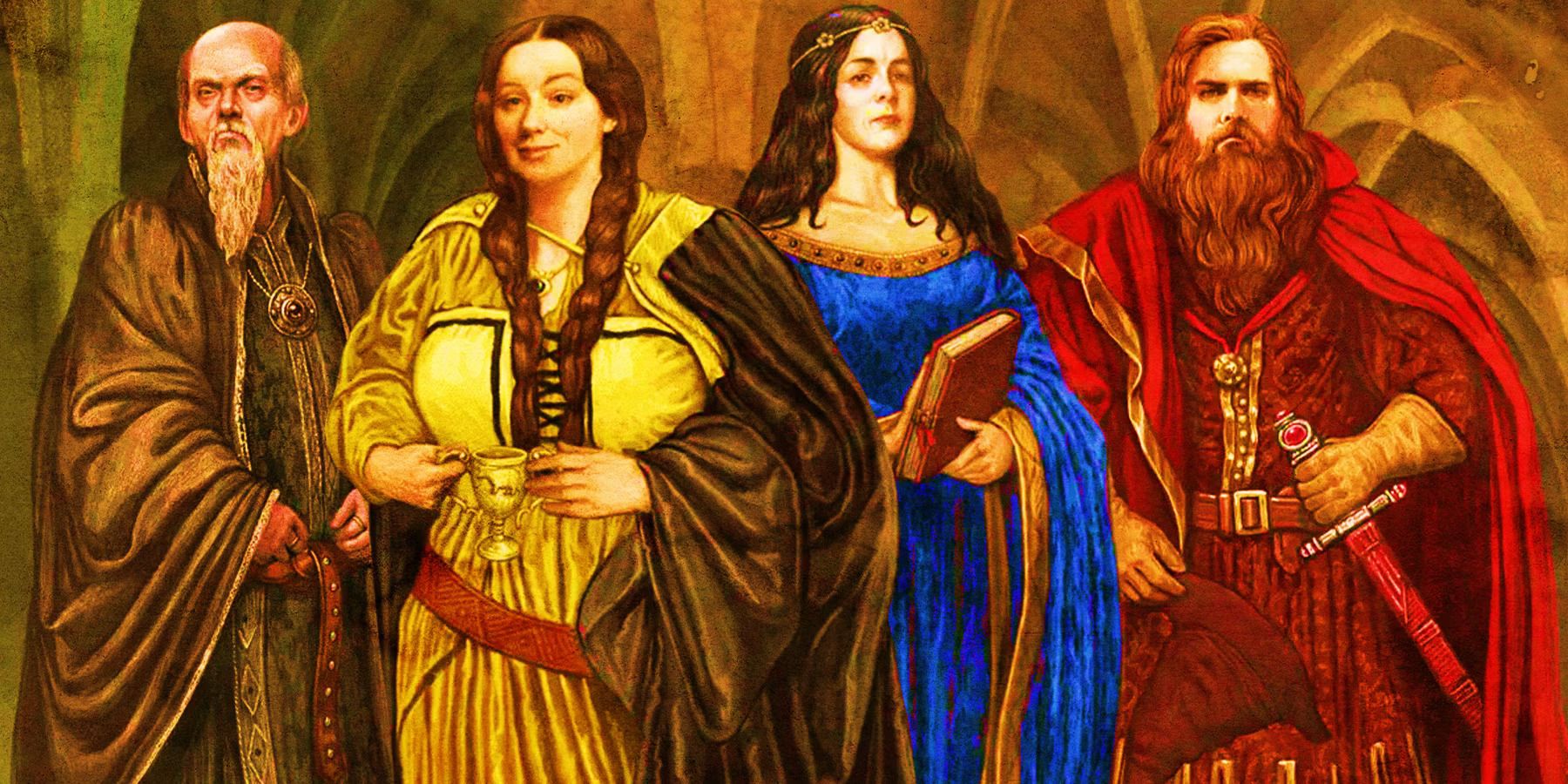
You’ve probably seen the four house crests a thousand times. The lion, the snake, the eagle, and the badger. They’re everywhere. But if you actually stop and think about it, the story of who are the founders of Hogwarts is way darker and more complicated than just a school mascot choice. It wasn't just four friends starting a private academy in the Scottish Highlands. It was more like a desperate, radical pact between four of the most powerful—and wildly different—magic users of the Middle Ages.
They lived in a time when being a wizard was basically a death sentence if you got caught by the wrong person. Muggles were terrified. Persecution was the norm. So, around the year 990 AD, Godric Gryffindor, Helga Hufflepuff, Rowena Ravenclaw, and Salazar Slytherin decided to build a fortress.
A sanctuary.
The Big Four: Not exactly a match made in heaven
Honestly, it’s a miracle the school lasted a week. You have four massive egos, each with a very specific idea of what "greatness" looks like.
Godric Gryffindor was the guy from the moors. He’s the one with the sword—literally, a goblin-made silver blade—who valued guts above everything else. He didn’t care if you were the smartest person in the room as long as you were willing to stand your ground when things got ugly. He was the quintessential warrior-wizard.
Then you have Helga Hufflepuff. She came from the broad valleys and brought something the others arguably lacked: a moral compass. While the other three were busy arguing over bloodlines and IQ points, Helga was the one saying, "I’ll teach the lot." She didn't want a specialized militia or an ivory tower of intellectuals. She wanted a community. It's why Hufflepuff house is often unfairly sidelined; her philosophy was the most inclusive, which doesn't always make for flashy history books, but it’s what keeps a society from eating itself.
Rowena Ravenclaw and the burden of genius
Rowena was from the glens. She’s often described as beautiful but somewhat intimidating. She wasn't just "smart" in a book-learning way; she was obsessed with the very architecture of logic. Legend says she’s the one who dreamt up the changing floor plan of Hogwarts. If the stairs are moving and the corridors lead nowhere, you can probably thank Rowena’s complicated mind for that. She wanted students whose brains worked like hers—sharp, restless, and constantly questioning.
The Slytherin problem
Then, of course, there’s Salazar Slytherin. He came from the fenlands, and he brought a specific kind of cunning that the others lacked. He was a Parselmouth, which was rare and, frankly, creepy to most people back then. While the others were focused on the present, Salazar was obsessed with the future—and specifically, the "purity" of that future.
The rift that almost leveled the castle
When we ask who are the founders of Hogwarts, we have to talk about why one of them eventually walked out. This wasn't just a small disagreement over the curriculum. It was a fundamental ideological war.
Salazar Slytherin didn't trust Muggle-borns. Period.
You have to remember the context of the 10th century. To Salazar, bringing a kid from a Muggle family into a secret magical fortress was a security risk. He thought they’d eventually betray the school to their families, who would then show up with torches and pitchforks. Gryffindor, who was originally Salazar’s best friend, absolutely hated this. The two of them clashed so hard it allegedly came to blows.
Salazar left. But he didn't go quietly.
He built the Chamber of Secrets. He tucked a Basilisk inside like a ticking time bomb, hoping that one day, an heir of his would "purge" the school of those he deemed unworthy. It’s a pretty grim legacy for a co-founder. It’s also why the Hogwarts we see in the books and films is constantly under a shadow. The school wasn't built on a foundation of perfect unity; it was built on a compromise that eventually snapped.
How they chose their students (and the Sorting Hat)
Early on, the founders hand-picked their students. Can you imagine? Getting an interview with Godric Gryffindor himself? But they realized they weren't immortal. They needed a way to keep the school running after they were gone.
Gryffindor literally took the hat off his head.
All four founders "enchanted" the hat, pumping it full of their combined intelligence and their specific preferences.
- Gryffindor wanted the brave.
- Ravenclaw wanted the sharpest minds.
- Hufflepuff wanted the hard workers and the loyal.
- Slytherin wanted the ambitious and the "pure."
This hat is essentially a living AI version of the founders' collective personalities. It’s why the Sorting Hat is so remarkably good at seeing things in kids that they don't even see in themselves yet. It’s carrying 1,000 years of the founders' expectations.
The artifacts they left behind
We can’t talk about who are the founders of Hogwarts without mentioning the stuff they left behind, most of which ended up becoming Horcruxes later on (thanks to Voldemort). Each item says a lot about the person who owned it.
- The Sword of Gryffindor: It only appears to "true Gryffindors" in times of need. It’s made of goblin-silver, meaning it doesn't need cleaning and actually absorbs things that make it stronger (like Basilisk venom). It’s a weapon, plain and simple.
- The Cup of Helga Hufflepuff: A small golden cup with two finely wrought handles and a badger engraved on the side. It was said to have magical properties, though they were never fully explored before it was turned into a dark object. It represents the "homestead" vibe Helga favored.
- The Diadem of Rowena Ravenclaw: A tiara that supposedly made the wearer wiser. The irony? Rowena’s own daughter, Helena, stole it because she was jealous of her mother’s intellect. It’s a tragic symbol of the pressure Ravenclaw put on her own kin to be "perfect."
- The Locket of Salazar Slytherin: Heavy gold with an "S" in green stone. It’s an heirloom that stayed in the family for generations, eventually landing with the Gaunts. It represents Slytherin’s obsession with lineage.
Why the "Four Founders" myth is actually complicated
Most people think of the founders as these static, legendary figures on a pedestal. But the truth is more nuanced. Historical accounts (well, the fictional-historical accounts we have from the Harry Potter universe) suggest they were deeply flawed.
Ravenclaw’s obsession with wisdom led to a fractured relationship with her daughter. Slytherin’s paranoia turned into blatant bigotry. Gryffindor’s bravado often bordered on recklessness. Hufflepuff is perhaps the only one who comes out looking genuinely decent, yet her house is the one that gets the least "glory" in the history books because she wasn't interested in self-promotion.
The school's motto is Draco Dormiens Nunquam Titillandus—Never Tickle a Sleeping Dragon. It’s a reminder that beneath the surface of this educational institution, there is ancient, dangerous power. That power comes directly from these four people.
Moving beyond the house colors
When you're trying to figure out who are the founders of Hogwarts, don't just look at the ties and the robes. Look at the architecture. Look at the Room of Requirement—some say that’s a leftover of the combined magic of all four founders. Look at the Great Hall.
The legacy of these four wizards isn't just a sorting system. It’s a survival story. They took a chaotic, dangerous world and carved out a space where magic could be studied safely. They failed in many ways—specifically in their inability to stay united—but they created something that outlasted their own petty feuds.
If you’re looking to apply this "expert knowledge" to your next re-watch or re-read, keep an eye on how the ghosts interact with the school. The Grey Lady (Rowena’s daughter) and the Bloody Baron (the man who killed her) are direct links back to that founding era. They are the living (well, dead) reminders that the drama of the founders never truly left the castle walls.
Actionable steps for the curious fan
To truly understand the depth of the Hogwarts founders, you should look into the following specific lore points:
- Research the "Bloody Baron" and Helena Ravenclaw: This story explains the end of Rowena Ravenclaw’s life and adds a layer of tragedy to the "wisdom" house.
- Trace the lineage of the Gaunt family: This shows how Salazar Slytherin’s bloodline eventually produced Tom Riddle, connecting the ancient past to the series' main conflict.
- Re-read the Sorting Hat's songs: Each book features a different song from the hat, and they often contain specific historical clues about the founders' falling out that you might have missed the first time.
- Visit the Wizarding World's official archives: Platforms like the old Pottermore (now Wizarding World) have specific essays by J.K. Rowling that provide the "canonical" backstories for each founder that aren't always fully explained in the main seven books.