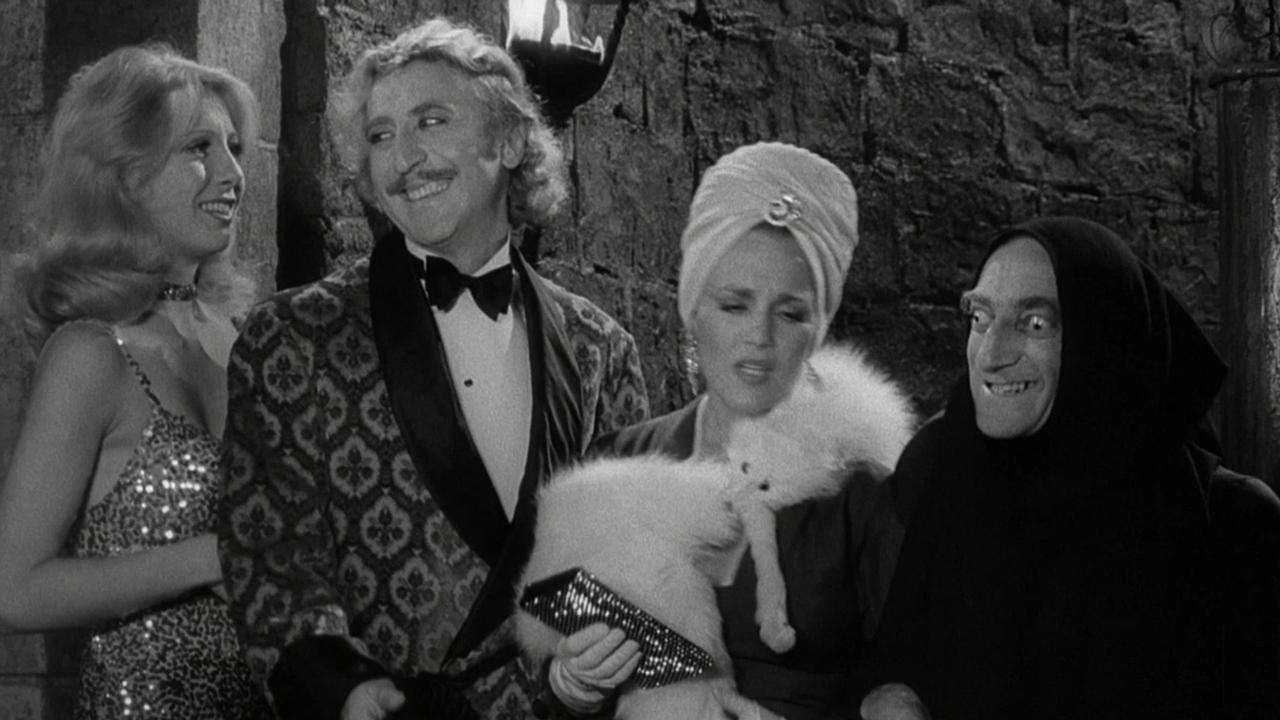
The eyes. They’re the first thing you think of. Honestly, they’re probably the only thing some people remember about the 1974 Mel Brooks classic. When someone asks who played Igor in Young Frankenstein, the name Marty Feldman usually follows a brief moment of trying to mimic that iconic, sideways stare.
He wasn't just a sidekick. Feldman’s Igor—pronounced "Eye-gor," naturally—redefined what a cinematic lackey could be. Before 1974, the hunchbacked assistant was a trope of gothic horror, usually a grim, pathetic figure like Dwight Frye’s Renfield or Fritz. Feldman turned that on its head. He made the character a fourth-wall-breaking, sarcasm-dripping prankster who seemed more in on the joke than the audience.
It’s wild to think he wasn't even the first choice for the vibe of the movie. Gene Wilder and Mel Brooks were deep into the script when the idea of this specific British comedian came up. Feldman had a face made for silent film and a wit sharp enough for the 70s comedy boom. It was a match that changed comedy history.
The Man Behind the Hump: Marty Feldman's Unlikely Path
Marty Feldman didn't start out as a Hollywood darling. Far from it. He was a jazz-loving high school dropout from the East End of London who spent years grinding in the UK comedy circuit. He was a writer first, really. He penned sketches for The Frost Report and worked closely with future Monty Python members.
But that face. It’s what made him a star. Feldman suffered from Graves’ disease, which caused his eyes to protrude significantly (proptosis). A botched surgery after a car accident only made the effect more pronounced. Instead of hiding it, he leaned in. He once famously described himself as having the "only face that could be used as a map of the underground."
By the time Mel Brooks called, Feldman was already a cult hit in Britain thanks to At Last the 1948 Show. But Young Frankenstein was his American breakout. He didn't just play the role; he improvised half the best bits.
Take the "shifting hump" gag. That wasn't in the original script. Feldman just started moving the prosthetic hump from shoulder to shoulder between takes. When Gene Wilder finally noticed and asked about it, Feldman simply deadpanned, "What hump?" It’s arguably the most famous line in the movie, born entirely out of Feldman's desire to mess with his co-stars.
Why "Eye-gor" Worked Where Others Failed
Most people forget how risky Young Frankenstein was. Shooting in black and white in 1974? Using the original laboratory props from the 1931 Frankenstein? It could have been a disaster. It could have been too "inside baseball" for a general audience.
Feldman’s performance bridged the gap. He provided the meta-commentary.
Think about the "Walk This Way" bit. It’s a simple physical gag—Igor hobbles with a cane, and Gene Wilder’s Dr. Frankenstein mimics the hobble. It’s silly. It’s basic. But Feldman’s timing makes it transcendent. He understood the rhythm of vaudeville. He knew that the joke wasn't just the walk; it was the earnestness with which he invited others to join his absurdity.
Interestingly, Feldman’s Igor is the only character who seems aware he’s in a movie. He looks at the camera. He winks at us. In a world of screaming villagers and lightning bolts, he’s the only one having a good time. That’s why, when people search for who played Igor in Young Frankenstein, they aren't just looking for a name. They’re looking for the guy who made the monster movie fun.
The Chemistry That Couldn't Be Faked
You can’t talk about Marty Feldman without talking about Gene Wilder. They were a comedic binary star system. Wilder was the high-strung, screaming intellectual; Feldman was the cool, chaotic neutral.
During the filming of the "Abby Normal" scene, the set was reportedly a mess because they couldn't stop laughing. Feldman’s delivery was so dry it practically crackled. Mel Brooks has often said that Feldman was the "soul" of the film’s comedy because he never tried to be funny. He just was.
There’s a specific nuance to Feldman’s Igor that often gets overlooked. He’s incredibly loyal but also completely useless. He forgets to mention the "sedative" until it’s too late. He brings back the wrong brain. Yet, you never hate him. He’s the physical embodiment of the film’s chaotic heart.
The Tragic Aftermath and a Lasting Legacy
Marty Feldman’s time in the spotlight was tragically short. He died in 1982 at the age of 48 while filming Yellowbeard in Mexico. The cause was a massive heart attack, likely exacerbated by his heavy smoking and the physical strain of the production.
It’s a bit of a "what if" scenario for film buffs. What else could he have done? He directed a few films, like The Last Remake of Beau Geste, which showed his surrealist chops. But he never quite recaptured the lightning in a bottle that was Igor.
The character has been played by others since, notably in the Broadway musical adaptation. Christopher Fitzgerald took on the role on stage, doing a fantastic job of channeling Feldman’s energy while making it his own. But even then, the costume, the eyes, and the cadence were all tributes to the man from the 1974 film.
Getting the Details Right: Common Misconceptions
People often confuse Igor with Ygor. In the original Universal movies, Bela Lugosi played a character named Ygor in Son of Frankenstein. That character was a broken-necked blacksmith, much darker and more vengeful.
Mel Brooks and Gene Wilder deliberately changed the name and the vibe. They wanted a character that felt like a contemporary comedian dropped into a 1930s sets. If you watch the movie closely, Feldman never actually acts like a servant. He acts like a roommate who happens to live in a basement.
Another common mix-up? The hump. In many versions of the Frankenstein mythos, the assistant has a fixed deformity. Feldman’s decision to make the hump mobile was a stroke of genius that mocked the very idea of horror tropes. It turned a physical disability into a comedic tool, which was a very "70s" way of handling subversion.
How to Appreciate Feldman’s Work Today
If you’re revisiting the film or showing it to someone for the first time, keep an eye on Feldman’s hands. He was a master of "small" physical comedy. The way he handles the brain jar, the way he holds his cane—it’s all choreographed like a dance.
- Watch for the Fourth Wall: Count how many times Feldman looks directly into the lens. It happens more often than you think and usually right after Wilder does something "serious."
- Listen to the Cadence: Feldman’s background in radio writing is evident. He knows exactly where the beat of a sentence is. "Walk this... way." The pause is everything.
- Compare to the Originals: If you really want to see the brilliance, watch ten minutes of the 1931 Frankenstein and then switch to Marty. The contrast is where the genius lies.
Marty Feldman remains the definitive answer to who played Igor in Young Frankenstein because he didn't just play a role; he created a language for modern parody. He taught us that you can be part of the story and a critic of it at the same time.
For anyone looking to dive deeper into 70s comedy or the history of the "assistant" trope, the next logical step is to track down Feldman's BBC work. His sketches in Marty (his self-titled variety show) provide the DNA for everything he brought to the Mel Brooks universe. Beyond that, reading Mel Brooks' memoir All About Me! offers some incredible behind-the-scenes anecdotes about Feldman's behavior on set—including his habit of hiding in the rafters to spook the crew. It’s clear that the man was just as much of a character as the hunchback he immortalized.