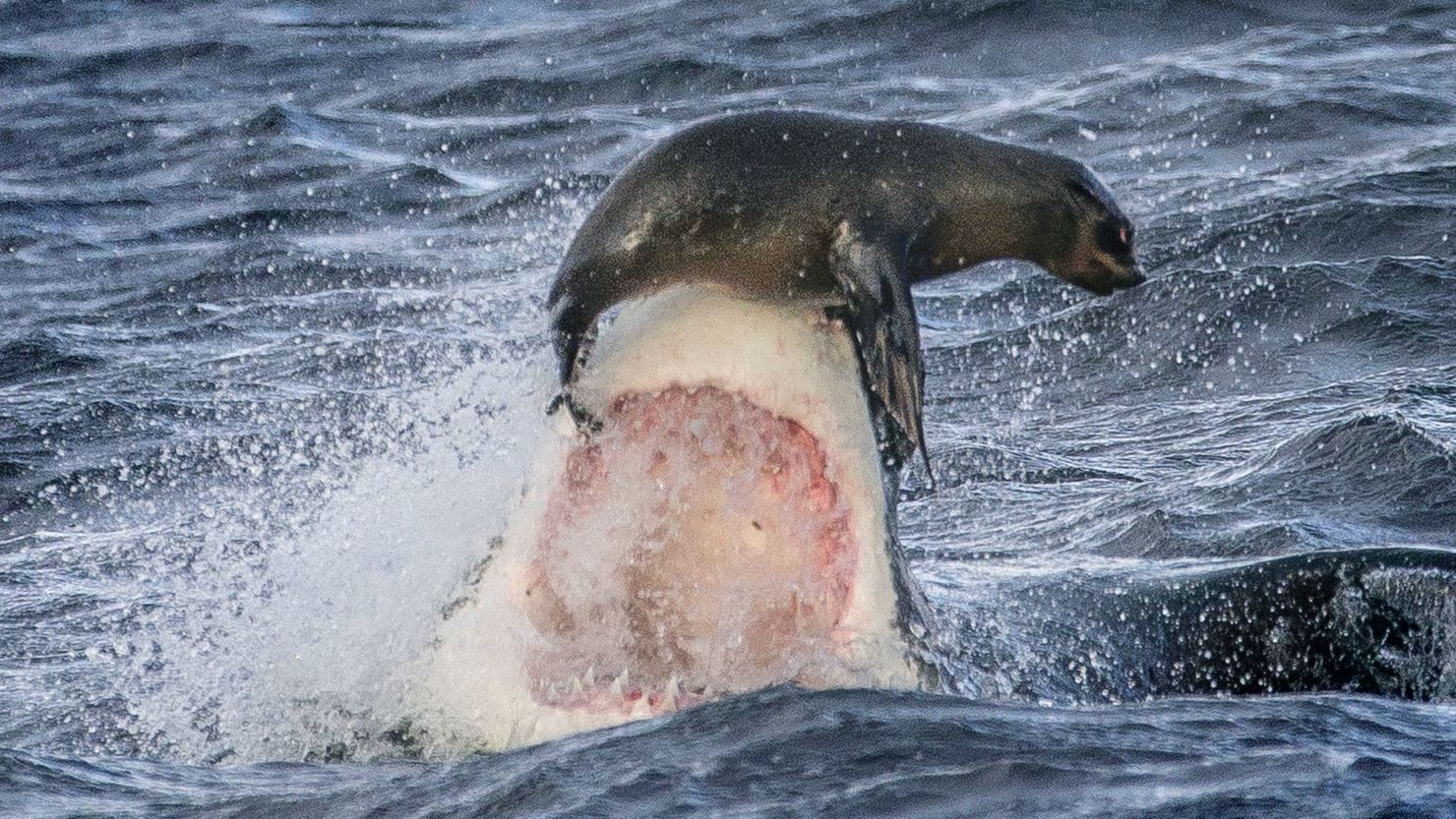
It’s a gray, foggy morning off the coast of Gansbaai, South Africa. The water is barely 55 degrees. You’re sitting in a boat, and suddenly, the surface of the ocean doesn't just ripple—it explodes. A 15-foot predator launches its entire two-ton body into the air, a Cape fur seal clamped in its serrated teeth. This is breaching. It’s violent. It’s messy. Honestly, it’s one of the most raw displays of physics you'll ever see on this planet.
People see a white shark eating seal and immediately think "monster." That’s the Jaws hangover talking. But if you actually look at the data from places like the Farallon Islands or Cape Cod, you realize this isn't a mindless buffet. It’s a high-stakes chess match where the shark actually loses more often than it wins.
The Strategy Behind a White Shark Eating Seal
Most people think the shark just swims up and bites. Not even close. If a Great White ( Carcharodon carcharias ) mess up the initial strike, the seal usually gets away. Seals are incredibly agile. They can literally turn on a dime, while a massive shark has the turning radius of a freight truck.
To win, the shark uses the "Polaris attack." They hunt from the depths, looking up. Because sharks have dark backs, they blend into the murky bottom. The seal, swimming at the surface, is silhouetted against the sun. The shark tracks that shadow, accelerates to nearly 25 miles per hour, and hits from below. It’s a vertical ambush.
Dr. Neil Hammerschlag, a renowned shark researcher, has spent years documenting these events. His research shows that sharks aren't just roaming aimlessly; they have specific "strike zones." They calculate the best light conditions and the best tides. If the sun is at a certain angle, the shark uses it to blind the seal. It’s tactical warfare.
Why Seals Aren't Easy Targets
Cape fur seals and Northern elephant seals aren't exactly helpless. They have whiskers that can detect the tiniest vibrations in the water. They have teeth. They have claws.
I've seen footage where a seal actually jumps onto the back of the shark’s head. Why? Because the shark can’t bite what it can't reach. The seal just hangs out there in the "dead zone" until the shark gets tired and gives up. It’s kind of hilarious if you forget about the stakes.
Also, elephant seals are huge. A bull elephant seal can weigh 4,500 pounds. That’s bigger than the shark. In those cases, the white shark eating seal scenario changes from a quick snack to a dangerous brawl. The shark has to be careful; a bite from a seal can cause a massive infection. Sharks don't have doctors. A bad wound can be a death sentence.
The Reality of "The Bite"
When the strike happens, the shark’s eyes roll back into its head. This is a protective mechanism called "nictitating membranes." Since they don't have eyelids, they have to protect their eyes from the seal's flailing claws.
This means that at the moment of impact, the shark is effectively blind.
They’re flying on instinct and the sensory input from their Ampullae of Lorenzini—those tiny pores on their snout that detect electrical fields. They can literally feel the seal’s heartbeat and muscle contractions.
The Ecosystem Needs the Carnage
It sounds gnarly, but the ocean would basically fall apart without this.
When you have a white shark eating seal, it’s a form of population control. Seals are voracious eaters. They go through massive amounts of fish. If sharks didn't keep seal populations in check, the seals would overfish the local reefs, leading to a total collapse of the smaller fish species.
It’s called a trophic cascade.
Think of it like this:
- Sharks eat the seals.
- Seals don't overpopulate.
- The fish population stays healthy.
- The kelp forests (which fish live in) stay lush.
Everything is connected. Even the leftovers matter. After a shark is done, the carcass sinks. This provides a "whale fall" style feast for bottom-feeders, crabs, and deep-sea worms. Nothing goes to waste in the Atlantic or the Pacific.
Where This Happens Most
If you’re looking to see this in person, there are a few global hotspots.
Seal Island, South Africa is the most famous. The topography of the island—a sheer drop-off into deep water—is perfect for that vertical breach.
Then you’ve got The Farallon Islands off San Francisco. The sharks there are some of the biggest in the world. They show up every autumn to hunt juvenile elephant seals. These seals are high in blubber (fat), which is exactly what a shark needs to fuel its migration across the "White Shark Cafe," a remote patch of the Pacific Ocean.
Lately, Cape Cod has become a major hub. Thanks to the Marine Mammal Protection Act, the gray seal population has exploded. Naturally, the Great Whites followed the food. It’s caused some tension with local tourism, but it’s a sign of a recovering ecosystem.
Common Misconceptions About the Hunt
One: Sharks eat every day.
Nope. Not even close. A big meal from a high-fat seal can sustain a Great White for weeks. They aren't "man-eaters" looking for a snack; they are energy-calculators. They want the most calories for the least amount of effort.
Two: It’s a "feeding frenzy."
Actually, Great Whites are surprisingly polite. When a kill happens, there’s often a social hierarchy. The biggest shark eats first. Smaller sharks wait their turn or keep their distance. They communicate through body language—dropping their pectoral fins or gaping their mouths—to avoid actual fighting. They’d rather share the seal than risk injuring each other.
Three: Humans are on the menu.
Honestly, we’re too bony. Compared to a blubbery seal, a human is like a rice cake. Most "attacks" on humans are "test bites." The shark is trying to figure out what we are. Unfortunately, a "test" from a Great White is a medical emergency for a human. But if they really wanted to eat us, the survival rate would be zero.
How to Respect the Event
If you ever find yourself on a boat watching a white shark eating seal, keep your distance.
Drones have changed everything for researchers. We can now watch these hunts from above without splashing around and interfering. If you’re a photographer, use a long lens. Don't chum the water near beaches.
We have to realize that we are entering their dining room.
Actionable Insights for the Curious
- Follow the Science: Check out the OCEARCH tracker. It’s an app that shows you exactly where tagged Great Whites are pinging in real-time. It’s wild to see how close they get to the shore.
- Support Conservation: Organizations like the Atlantic White Shark Conservancy do incredible work in education and safety. They help beachgoers coexist with these predators.
- Be Shark Smart: If you're swimming in areas like Cape Cod or Northern California, avoid swimming near seal colonies. Avoid murky water and dawn/dusk hours. That’s when the "Polaris attack" is most likely to happen.
- Watch the Documentaries: Skip the sensationalized "Shark Week" dramas. Look for documentaries narrated by actual biologists like Greg Skomal or Alison Kock. They provide context that isn't just "scary music and blood."
At the end of the day, a white shark eating a seal isn't a tragedy. It’s a heartbeat. It’s the sound of an ocean that is still alive and functioning. We’re lucky to live in a world where these prehistoric giants are still patrolling the blue, keeping the balance exactly where it needs to be.