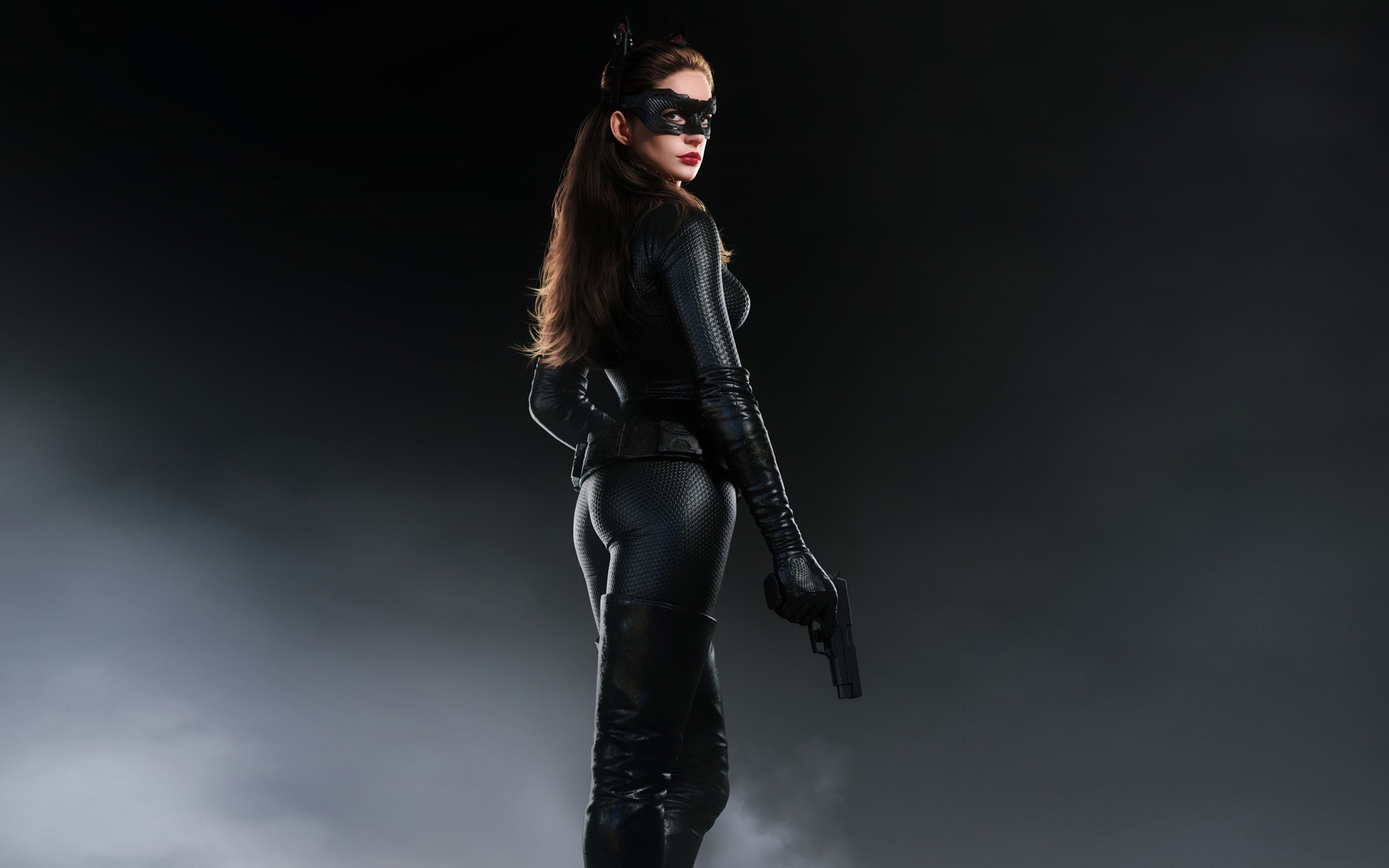
Christopher Nolan didn't want her. Honestly, that’s the starting point for Catwoman in The Dark Knight Rises. When the rumors started swirling around 2010 that Selina Kyle might show up to close out the trilogy, Nolan was hesitant because he wasn't sure how a "cat-themed" burglar fit into the gritty, hyper-realistic Gotham he’d built with Christian Bale. He needed a character who felt like a survivor, not a mascot.
Enter Anne Hathaway.
She didn't just play a thief; she played a desperate woman living in a world where the economy had failed everyone but the 1%. People forget how much of her performance is rooted in the 2008 financial crisis and the "Occupy Wall Street" energy of that era. When she whispers to Bruce Wayne about the "storm" coming, she isn't just being cryptic. She’s being a prophet.
The Problem with the "Catwoman" Label
The movie never actually calls her Catwoman. Not once. She’s Selina Kyle, a high-end grifter with a record she desperately wants to erase. That’s a massive distinction. Most comic book movies lean into the codenames, but Nolan’s world was always a bit too self-serious for that. Instead, we get a Selina who uses "cat-like" traits as a tactical advantage rather than a costume choice.
Look at the goggles.
In the comics, the ears are just... ears. In The Dark Knight Rises, those iconic points are actually night-vision flip-up lenses. When they're not in use, they rest on her head and look like ears. It's brilliant. It’s practical. It’s basically the most "Nolan" thing ever. She’s not dressing up to be scary; she’s dressing up to see in the dark while she cracks a safe.
Hathaway’s take was a sharp pivot from Michelle Pfeiffer’s legendary turn in Batman Returns. Where Pfeiffer was operatic and undead, Hathaway is athletic and grounded. She’s a street survivor who learned how to fight because she had to.
Selina Kyle as the Moral Mirror to Bruce Wayne
Bruce Wayne is a billionaire who plays at being a hero. Selina is a pauper who plays at being a villain because it pays the bills. That’s the friction.
Throughout Catwoman in The Dark Knight Rises, her primary motivation is the "Clean Slate"—a mythological computer program that can wipe a person’s criminal history from every database on Earth. She’s obsessed with it. She betrays Batman to Bane specifically to get it. That’s not a "villain" move in the traditional sense; it’s a desperate move by someone who knows the system is rigged against her.
She’s a pragmatist. When Batman tells her "no guns," she rolls her eyes. Why? Because guns work. She’s not interested in theatricality or symbols; she’s interested in results.
Interestingly, Hathaway spent months training in martial arts and stunt work to ensure she didn't look like a dancer playing a fighter. She looked like someone who could actually take down a man twice her size by using leverage and speed. If you watch the scene where she takes out the guards in the bar, her movements are short, jagged, and efficient. No wasted energy.
Why the 2012 Backlash Was Wrong
When the first images of the suit leaked, the internet hated it. They called it "cheap" or "boring." But in the context of the film, the simplicity is the point. Selina Kyle doesn't want to be noticed. She wears a tactical catsuit because it’s flexible and hides her identity, not because she wants to stand out on a rooftop.
Critics at the time, like Rex Reed, were skeptical about Hathaway’s casting, but she ended up winning a Saturn Award for the role. She brought a dry, cynical wit that balanced Christian Bale’s gravelly intensity. She’s the only person in the entire trilogy who calls Bruce out on his "theatricality" without sounding like a lectured villain.
The Combat and the Batpod
One of the most impressive feats of Catwoman in The Dark Knight Rises is Selina’s mastery of the Batpod. While Bruce drives it like a tank, Selina drives it like a weapon. The scene where she uses the onboard cannons to blast through the barricade—despite Batman’s "no killing" rule—is a pivotal moment for her character. It shows she isn’t his sidekick. She’s an ally of convenience who maintains her own agency.
She stays true to herself. Even at the end, when Gotham is literally a war zone, she’s looking for the exit. She only stays to help because Bruce represents the only person who actually saw her for who she was, rather than what she stole.
How to Re-watch Her Performance Today
If you’re going back to watch the trilogy, pay attention to Selina’s voice. Hathaway does this incredible thing where she changes her tone based on who she’s talking to. When she’s playing the "victim" for the police, her voice is high, breathy, and helpless. The second they turn their backs, her voice drops an octave. It’s cold. It’s calculating.
It’s the best representation of Selina Kyle as a "chameleon" we’ve ever seen on screen.
Actionable Insights for Fans and Cinematophiles
To truly appreciate the nuance of this version of the character, there are a few things you should look for in your next viewing:
- Study the "Clean Slate" Subplot: Notice how Selina’s desperation for a fresh start mirrors Bruce’s own desire to escape the mantle of the Bat. They are both looking for a way out of the lives they’ve built.
- The Costume Evolution: Observe how Selina's "uniform" only becomes complete when she is working toward a specific goal. She doesn't just "put on the suit" for fun; every piece of gear has a utility.
- The Fighting Style: Compare Hathaway's stunt work to Bale's. Batman uses the Keysi Fighting Method, which is heavy and brutal. Selina uses a mix of Muay Thai and gymnastics, emphasizing evasion over direct confrontation.
- Social Commentary: Contextualize her dialogue within the 2012 socio-economic climate. Her warnings to Bruce about the "wealthy" are some of the most pointed political lines in any modern superhero film.
Selina Kyle in this film isn't just a love interest or a villain. She is the bridge between the high-flying world of the Wayne family and the crumbling streets of Gotham. She’s the most "human" part of the finale.
The character remains a high-water mark for how to adapt comic icons into a realistic setting without losing their soul. To get the most out of the experience, watch the film alongside the "Behind the Scenes" features on the Dark Knight Trilogy Blu-ray, specifically the segment "The Batmobile," which details how they taught the stunt teams to handle the Batpod for Hathaway's sequences. Understanding the physical difficulty of those scenes makes her performance even more impressive. You can also track the character's influence on later iterations, like Zoë Kravitz’s version, which takes the "street-level survivor" DNA established by Hathaway and pushes it even further.