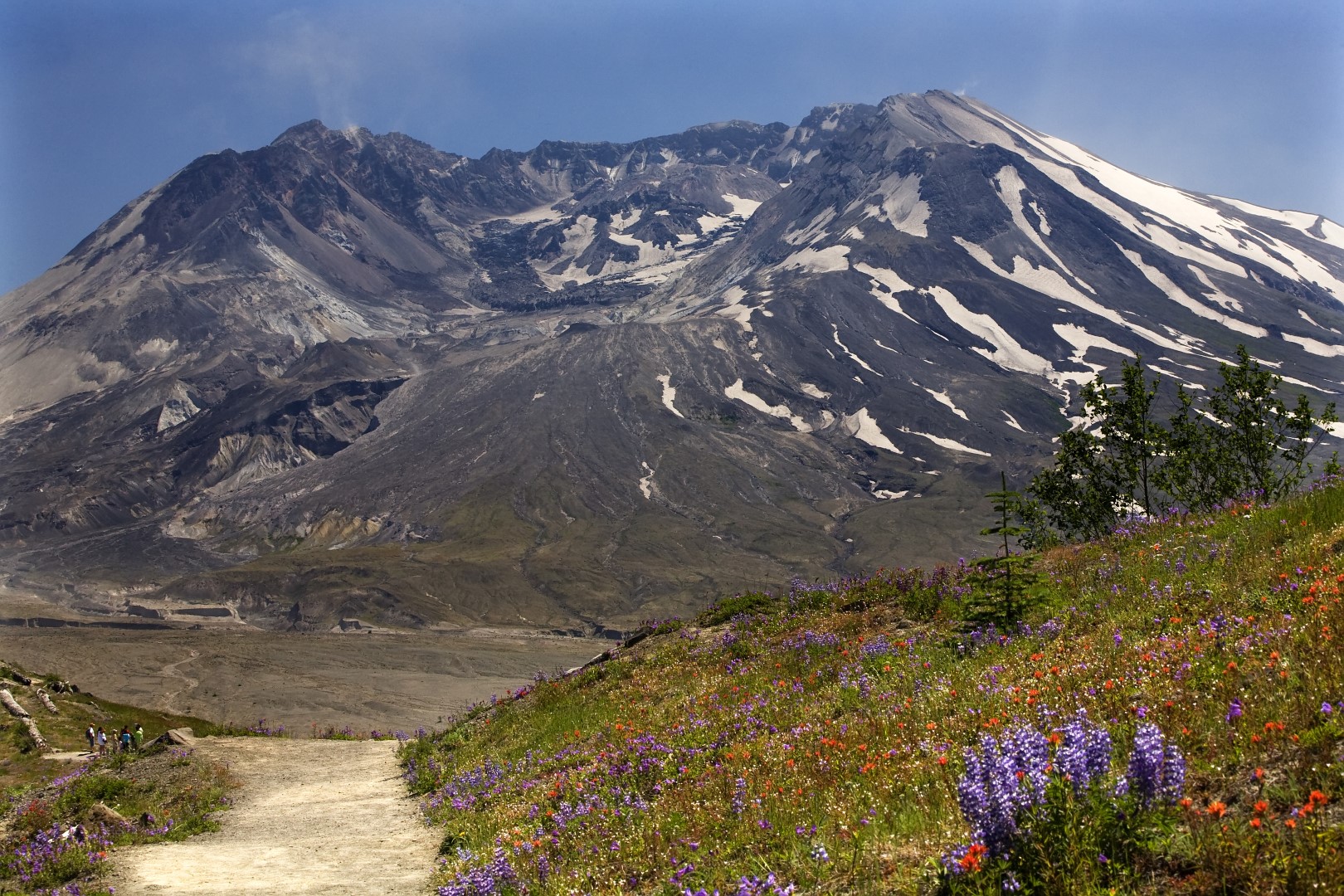
It was a Sunday morning. May 18, 1980. For weeks, the mountain had been bulging, literally growing a "tumor" on its north face at a rate of five feet per day. People were watching. Some were camping closer than they should have been. Then, at 8:32 a.m., a magnitude 5.1 earthquake triggered the largest landslide in recorded history. The mountain didn't just erupt; it disintegrated. When you look at photos of mt st helens before and after, you aren't just looking at a geological change. You’re looking at the moment a 9,677-foot peak lost 1,300 feet of its height in seconds.
Honestly, the "before" shots look like a postcard from the Swiss Alps. Spirit Lake reflected a perfect, symmetrical cone covered in deep green Douglas firs. It was pristine. The "after" shots? They look like the surface of the moon, or a grayscale nightmare where everything living was simply erased.
The North Side Bulge: A Warning Ignored
Geologists like David Johnston knew something was up. He was stationed on Coldwater II, a ridge about six miles from the crater. If you see the photos of the north flank from early May 1980, the mountain looks deformed. It’s lopsided. That bulge was caused by magma pushing up but getting trapped.
The pressure was insane.
When the landslide happened, it was like uncorking a shaken champagne bottle. The lateral blast—the explosion that went sideways instead of just up—traveled at 300 miles per hour. It caught everyone by surprise. Most people expected a vertical eruption, like a chimney. Nobody expected the mountain to unzip sideways. The "after" photos of the blast zone show trees snapped like toothpicks, all laying in the same direction, radiating away from the crater. Over 230 square miles of forest vanished. Just gone.
Spirit Lake: From Blue Gem to Log Jam
One of the most jarring comparisons in the archive of photos of mt st helens before and after involves Spirit Lake. Before the eruption, it was a premier vacation spot. Harry R. Truman, the crusty old owner of the Mount St. Helens Lodge, famously refused to leave. He’s still there, buried under hundreds of feet of debris.
The "after" images of the lake are barely recognizable as water. The landslide slammed into the lake, creating a massive wave that stripped trees off the surrounding slopes 800 feet up. When that water settled back down, it carried thousands of shattered logs with it. Even today, decades later, a massive "log mat" of thousands of silvered, dead trunks still floats on the surface. It moves with the wind. It’s a graveyard of a forest that died in 1980.
The Ash That Traveled the World
It wasn't just the mountain that changed. The sky did, too. The eruption sent a plume of ash 80,000 feet into the air in less than 15 minutes.
- Yakima, Washington: Went pitch black in the middle of the day.
- Eastern Washington: Farmers had to wear masks just to breathe while checking crops.
- The Atmosphere: Ash circled the entire globe in about two weeks.
If you find old Polaroids from that week in places like Spokane or Ritzville, the "after" isn't a landscape—it's a streetscape buried in grey, gritty powder. It looked like snow, but it didn't melt. It stayed. It wrecked car engines and clogged lungs.
How the Landscape Is Finally Fighting Back
Nature is stubborn. If you visit the Mount St. Helens National Volcanic Monument now, the photos of mt st helens before and after have a third chapter: the "now."
For years, scientists thought the blast zone would be sterile for a century. They were wrong. Lupines were the first to come back. They’re nitrogen-fixers, meaning they could grow in the volcanic ash that lacked basic nutrients. Then came the gophers. Because they lived underground, many survived the heat. Their tunneling mixed the old soil with the new ash, basically rototilling the wasteland back to life.
You can see the green returning in satellite imagery. The "after" photo is no longer just grey. It’s a mosaic. Elk have returned in massive numbers. Willow and alder trees are choking the stream banks. But the old-growth forest? That's not coming back in our lifetime. Those trees take hundreds of years to reach the scale of what was there on May 17th.
What the Camera Doesn't Always Capture
We talk about the visuals, but the scale is hard to grasp through a screen. The crater left behind is a horseshoe shape, two miles wide. Inside that crater, a new lava dome is growing. It’s a living, breathing volcano. It’s quiet now, mostly, but the steam plumes you see in modern photos are a reminder that the "after" is just a temporary state.
Gary Braasch, a famous nature photographer, spent years documenting the recovery. His work shows the nuance that quick "before and after" clicks miss. He captured the tiny spiders that ballooned in on the wind, the first mosses, and the way the mudflows (lahars) reshaped the Toutle River. The riverbeds were raised by so much debris that they still have to be dredged today to prevent flooding in downstream towns like Longview.
Actionable Insights for Your Visit
If you’re planning to head out there to see these changes for yourself, don't just go to the first viewpoint you see.
- Hit the Johnston Ridge Observatory. It’s named after David Johnston (the guy who yelled "Vancouver! Vancouver! This is it!" before he was gone). It sits right in the path of the blast. The view into the crater is raw.
- Look for the "Ghost Forest." On the edges of the blast zone, you can find the "standing dead"—trees that were seared by the heat but not knocked down. They look like bone-white skeletons against the new green growth.
- Check the Hummocks Trail. You’ll walk through the actual pieces of the mountain. Those "hills" in the valley aren't hills; they are massive chunks of the summit that landed there during the landslide.
- Ape Cave is a different story. It’s a lava tube on the south side. The south side didn't get hit by the blast, so the "before and after" there is much less dramatic. Go there if you want to see what the whole mountain used to look like—lush, green, and deep forest.
The most important thing to remember is that Mount St. Helens isn't "recovered." It's different. It’s a brand-new ecosystem built on the ruins of the old one. The photos remind us that the earth doesn't care about our property lines or our lodges. It moves, it breaks, and eventually, it starts over.
What to Do Next
To truly understand the scale, start by browsing the USGS Cascades Volcano Observatory digital archives. They have the most scientifically accurate high-resolution comparisons. If you're going in person, check the WSDOT (Washington State Department of Transportation) site for Spirit Lake Memorial Highway (SR 504) closures. The road is frequently affected by landslides because the ground is still unstable from 1980. Pack a physical map; cell service in the blast zone is basically non-existent.